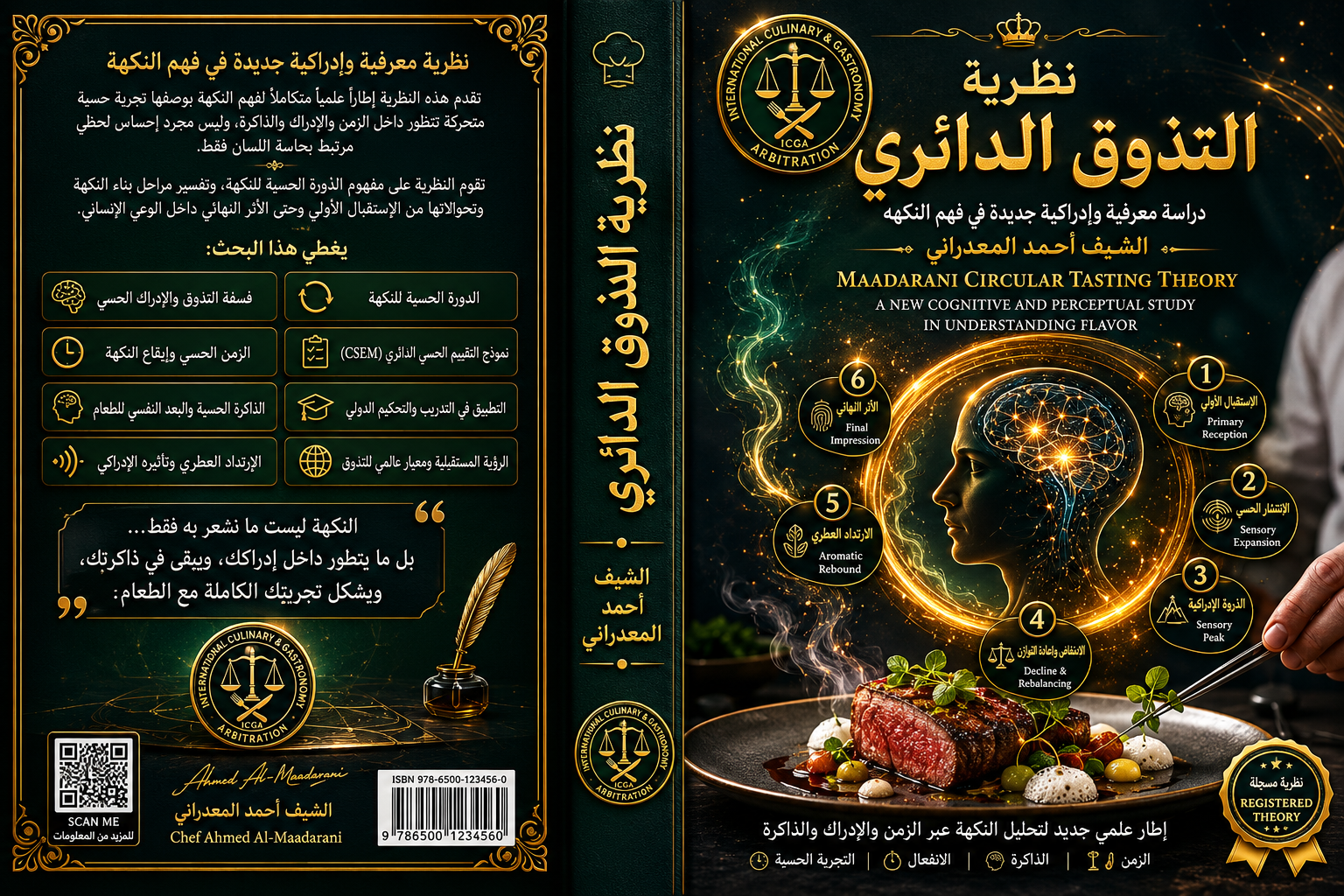
Maadarani, A. (2026). Culinary Adjudication Measurement Science: Founding a New Science for Measuring Dish Quality, Judge Reliability, and Decision Fairness. Master Chefs International Journal, IUOAMC Global Platform.
The Culinary Judging Event as the Basic Unit
Scientific Thesis
A culinary judging event is the recorded interaction between a dish, a judge, a context, and a moment in time; it is the smallest analyzable unit of the new science.
Position within CAMS
This part defines the objects and units of the new science. A judging event is not produced by the dish alone; it emerges from the interaction of dish, judge, context, and time. The score is therefore analyzed as the outcome of a composite relation rather than as an isolated number.
The subject of “The Culinary Judging Event as the Basic Unit” is treated as an operationally definable component rather than a general verbal opinion. The term must be connected to a specific judging event, retainable data, and a declared method for distinguishing observation from inference. This separation prevents personal expertise from becoming authority that cannot be reviewed.
Proposed Foundational Rule
A culinary judging event is the recorded interaction between a dish, a judge, a context, and a moment in time; it is the smallest analyzable unit of the new science. This rule is a foundational hypothesis within the new science. Its future strength depends on testing, reapplication, and comparison of results, not on declaration alone. A clear distinction is maintained between founding a scientific field and claiming that all of its laws have already received empirical confirmation.
Operational Definition and Measurement
Each event receives a record connecting the coded sample, judge code, tasting order, temperature, recording time, score, confidence, and any change after contextual disclosure. This makes it possible to reconstruct the decision step by step.
The process begins by defining the target variable, choosing a baseline, and conducting a comparison under known conditions. Raw score, confidence, time, and stage are recorded before any composite indicator is produced. Values that conflict with panel expectation must not be concealed because they may reveal a problem in the sample, judge, or procedure.
Applied Procedure
- Define the purpose before tasting begins.
- Code the dish and judge and conceal unnecessary information.
- Record score, confidence, and time independently.
- Conduct the required comparison or repeat.
- Calculate and interpret the difference before confirmation.
- Preserve the record for review and verification.
Field of Use
This structure applies to competitions, competency examinations, panel training, cross-round performance comparison, and the investigation of fairness-related objections.
Testable Hypothesis
This chapter proposes that integrating “The Culinary Judging Event as the Basic Unit” into session design will increase the panel’s ability to explain scores, reduce untraceable decisions, and make professional disagreement analyzable rather than a confrontation between preferences. The proposition must be tested across multiple sessions before final thresholds are fixed.
Scientific Integrity Controls
This is an original foundational work and contains no external reference list. Concepts, laws, equations, and protocols are therefore presented as scientific constructs proposed by the founder, while practical effects remain subject to testing, calibration, and independent review. The absence of external references does not remove the need for evidence; it makes the production of empirical evidence a necessary next phase.
Section Conclusion
This component adds a defined building block to CAMS by connecting a decision with its conditions, source, and method of measurement while preserving the role of human expertise. The goal is not to replace the judge, but to make adjudicative authority fairer, clearer, more responsible, and capable of systematic development.