
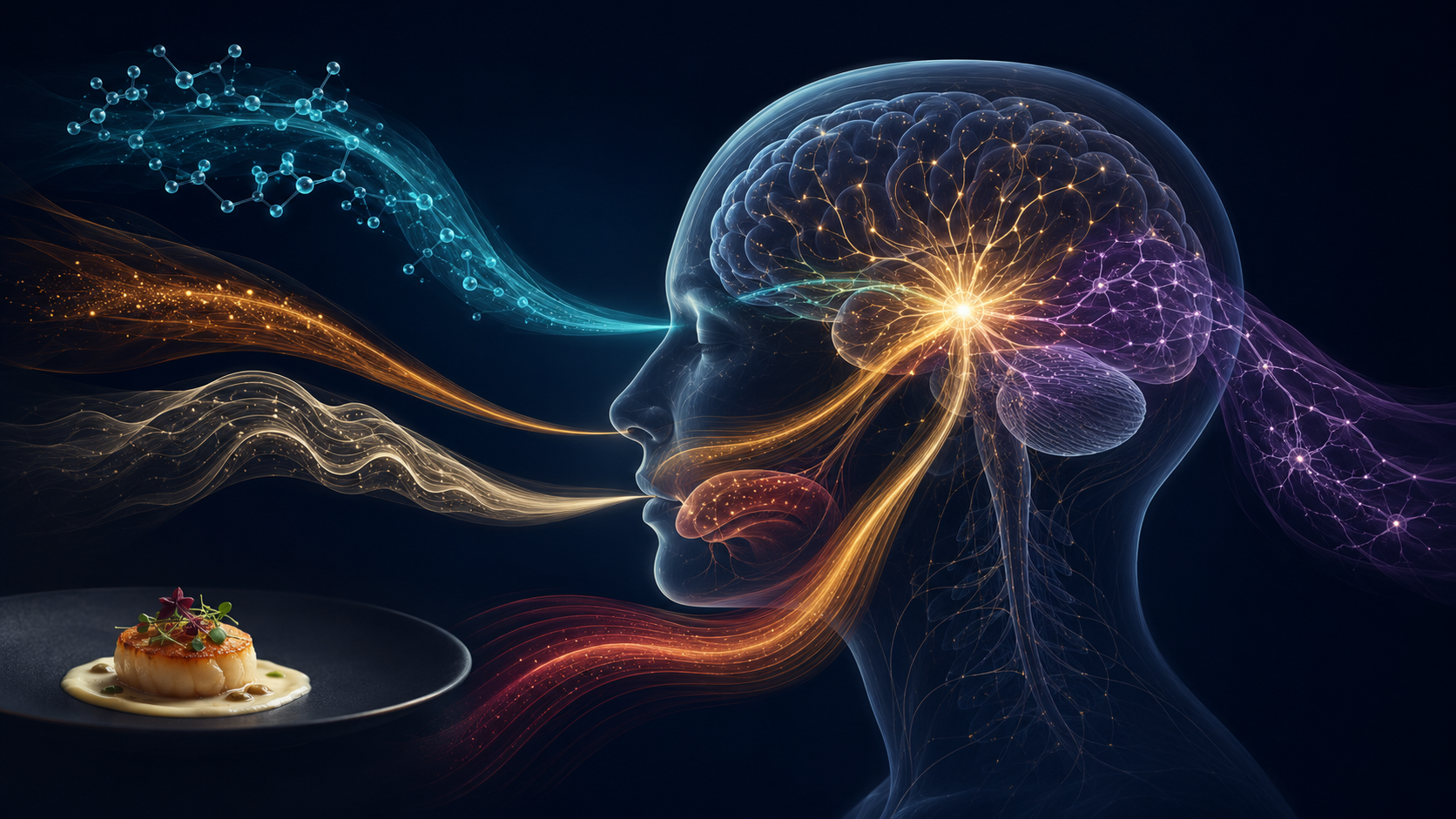
Maadarani, Ahmad. (2026). Tasting does not occur in the tongue alone: From chemical taste to flavor construction in the brain. IUOAMC Scientific Magazine, International Union of Arab Master Chefs. Research Archive Code: IUOAMC-MV2-2026-FNS-001.
Tasting Does Not Occur in the Tongue Alone
From Chemical Taste to Flavor Construction in the Brain: A Study of the Integration of the Tongue, Retronasal Olfaction, and Oral Sensation
Introduction
One of the most common errors in understanding tasting is the assumption that the tongue is the sole organ responsible for the experience of food and the construction of flavor. Although the tongue plays an essential role in detecting tastes, it cannot independently produce the aromatic complexity associated with coffee, vanilla, citrus fruits, herbs, spices, or grilled meat.
People do not consume food with the tongue alone. They see, smell, touch, and move it inside the mouth. They perceive its temperature, texture, and chemical effects and compare these signals with previous experiences, memories, and expectations. The brain then integrates this information into a unified experience known as flavor.
When someone says that a dessert “tastes of vanilla,” coffee has a “roasted taste,” or a dish has an “herbal taste,” the word taste is being used in its broad everyday meaning. Scientifically, vanilla, roasting, and herbs are not basic tastes independently detected by the tongue. They are aromatic identities whose perception depends substantially on the olfactory system, particularly retronasal olfaction during oral processing.
This study examines how flavor is constructed, distinguishes among taste, odor, flavor, and tasting, and explains the integration of the tongue, nose, oral-sensory systems, and brain. It also examines the implications of this understanding for sensory training, judging-form design, and the achievement of accuracy, consistency, and fairness in professional evaluation.
The study begins with a clear central principle:
The tongue detects taste, but the brain constructs flavor.
First: The Difference Between Taste, Flavor, and Tasting
In everyday language, the word taste is often used to describe the entire food experience. Scientific usage, however, requires a distinction among concepts that may appear similar but perform different functions.
Taste
Taste is the sensation produced primarily when dissolved compounds interact with gustatory receptors located in the taste buds and oral cavity. The most widely recognized basic tastes are:
- Sweetness.
- Saltiness.
- Sourness.
- Bitterness.
- Umami.
The gustatory system can therefore identify important aspects of the chemical composition of food, but it cannot independently determine its detailed aromatic identity.
A person may recognize that a sample is sweet but require smell to determine whether it has a strawberry, vanilla, or mango flavor. Similarly, a person may detect bitterness in a beverage, but identifying it as coffee, cocoa, or a botanical extract depends on additional aromatic and sensory information.
Odor
Odor is the perception produced when volatile compounds reach the olfactory receptors. These compounds may arrive from the external environment through the nostrils or from food inside the mouth through the posterior pathway leading to the olfactory region.
Flavor
Flavor is the complex experience created through the integration of taste, retronasal aroma, texture, temperature, chemical stimulation, and other sensory and perceptual information.
Flavor is therefore not scientifically synonymous with taste. Taste is one of its components, not the entire experience.
Tasting
Tasting is the act of receiving and analyzing the properties of food or drink. It may be a spontaneous everyday experience, an organized sensory analysis, a professional evaluation, or formal judging intended to produce a documented decision.
The following principle can therefore be adopted:
Taste is a component of flavor; flavor results from sensory integration; and tasting is the process through which this system is perceived, interpreted, and evaluated.
Second: What Can the Tongue Do?
The tongue is central to the detection of tastes. It also helps move food, mix it with saliva, form the bolus, and direct it toward swallowing. Its movements contribute to breaking down food and releasing aromatic compounds.
However, the tongue is not an independent and complete flavor-producing organ. It cannot independently recognize the thousands of aromas and aromatic identities that distinguish food products.
The old belief that the tongue is divided into exclusive regions—with the tip detecting only sweetness and the back detecting only bitterness—is an inaccurate oversimplification. Multiple areas of the tongue can respond to different tastes. Relative differences in sensitivity may exist, but there is no closed and exclusive region for each taste.
Basic tastes do not function independently of one another. Sweetness may reduce perceived bitterness or sourness, and an appropriate amount of salt may enhance certain aspects of sweetness or savory depth. Excessive concentration of one component, however, may obscure other characteristics.
Professional taste evaluation must therefore examine more than the presence of sugar, salt, or acid. It should consider:
- The type of taste.
- Its intensity.
- The timing of its appearance.
- Its relationship with other tastes.
- Its persistence after swallowing.
- Its compatibility with the product’s identity.
- The presence of imbalance, excess, or deficiency.
- Its effect on the product’s final balance.
Third: Orthonasal Olfaction and the Construction of Expectation
Orthonasal olfaction occurs when volatile compounds from the external environment enter through the nostrils. It is the pathway used when smelling food before eating, approaching a cup of coffee, or entering a place filled with the aroma of bread or spices.
Orthonasal olfaction helps create an initial impression and expectations before food enters the mouth. An aroma may suggest ripeness, freshness, burning, fermentation, oxidation, or the presence of particular spices.
Related Research
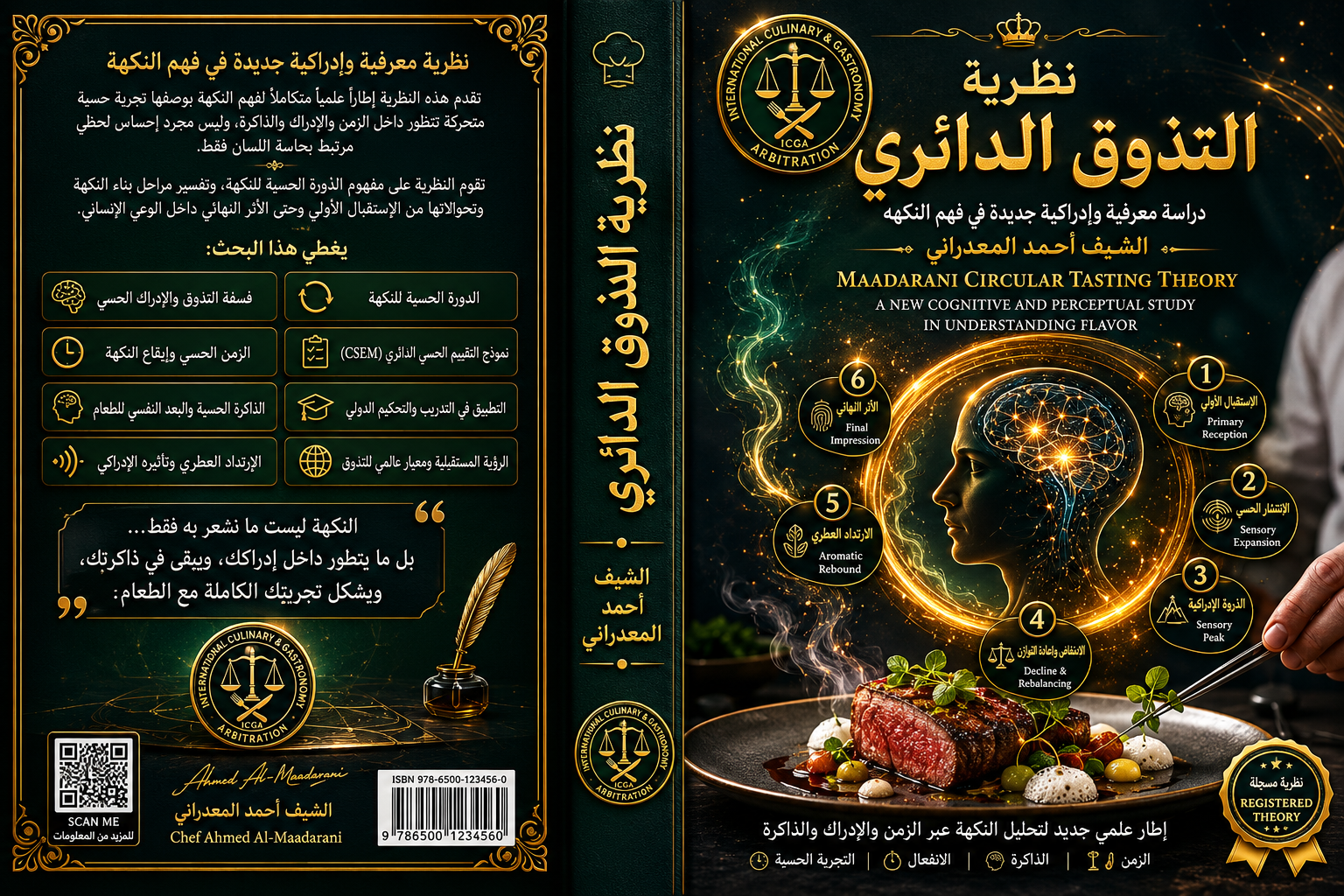
IUOAMC-MCTT-2026-001