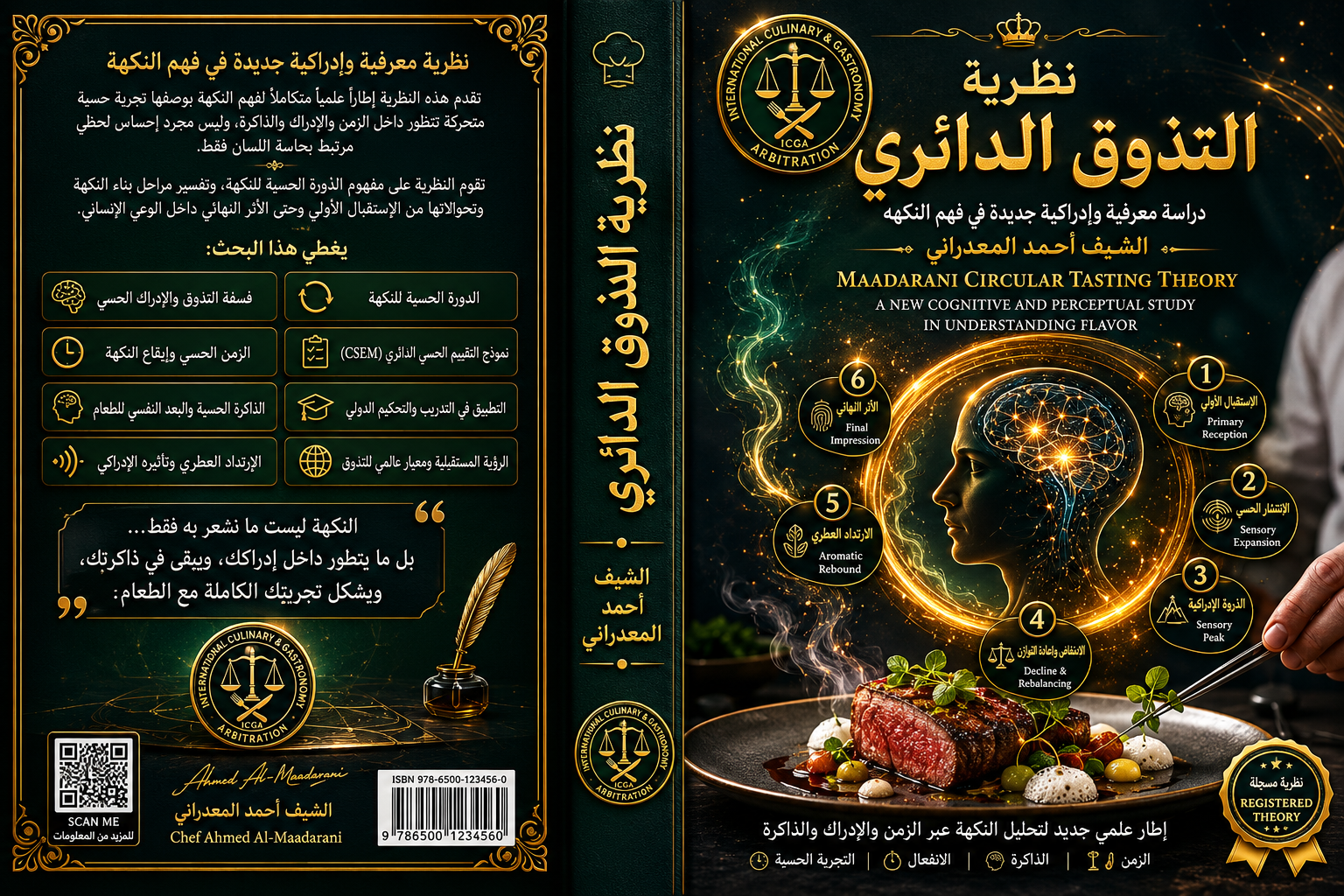
المعدراني، أحمد. (2026). نظرية التذوق الدائري: دراسة معرفية وإدراكية جديدة في فهم النكهة. IUOAMC Global Platform.
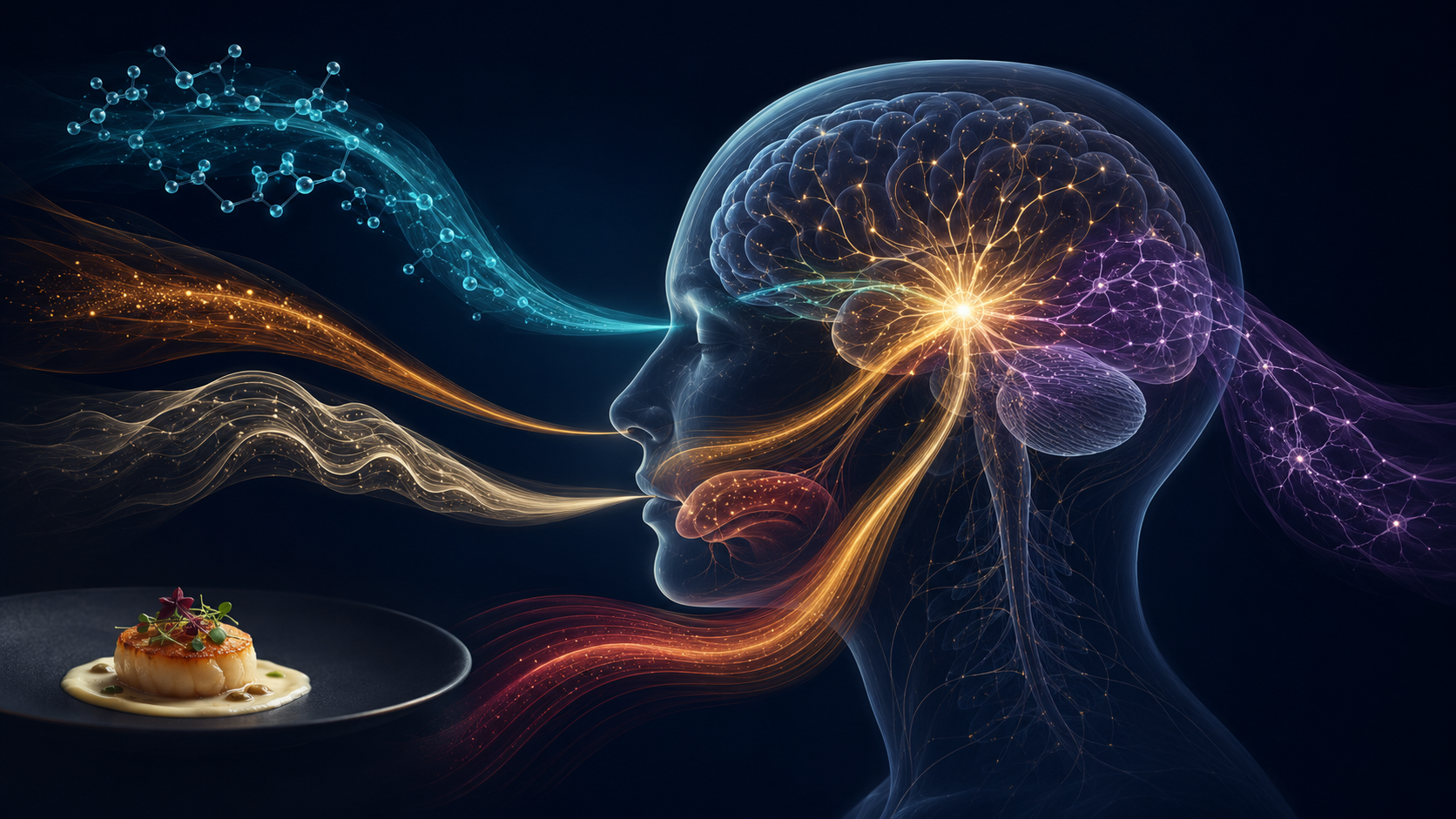
From the perspective of circular tasting, the brain is not merely an analytical tool. It is an actual partner in making flavor. Food does not possess complete sensory meaning outside neural perception, because the final experience arises from the ongoing interaction between the food substance and the human perceptual structure.
Thus, the theory affirms that understanding flavor cannot be limited to studying food alone. It must also include studying how signals move inside the brain and how neural perception reshapes the sensory experience through time. Tasting is therefore a mental process as much as it is a sensory one.
The Relationship Between Senses and Time in Flavor Construction
Circular Tasting Theory holds that flavor is not built by the senses alone, nor by time alone, but by the reciprocal relationship between them. The senses provide the initial signals of food, while time gives those signals the ability to develop, transform, and reshape themselves within perception. Without time, flavor remains superficial and direct. Without the senses, time is empty of sensory experience.
In the first moment of tasting, the senses work very quickly to capture the basic signals of food. Yet these signals do not reach their final form immediately, because the brain needs time to analyze them and link them to aromas, texture, heat, memory, and psychological emotion. The true tasting experience therefore does not happen in a single moment. It takes shape gradually as time passes.
The theory proposes that time is not merely an external factor passing during tasting, but a “perceptual environment” within which the senses move. Every additional second allows new flavor layers to appear and gives the brain an opportunity to reinterpret sensory signals more deeply. Some foods therefore require slowness and contemplation in order to be understood correctly.
The theory uses the concept of Sensory Time Interaction. This refers to the way sensory responses change as the temporal cycle of food develops. Aroma may be weak at first and then become clearer later. Texture may appear first and then be followed by thermal effect or delayed aromatic taste. These transformations do not occur randomly, but within a perceptual sequence that forms the identity of flavor itself.
The speed of tasting also affects the nature of sensory perception. Fast tasting may prevent the appearance of certain delicate layers, while slow tasting allows flavor to develop and delayed effects to emerge. The “temporal rhythm” of food therefore becomes part of the tasting experience, not merely a way of eating.
This is especially evident in specialty coffee, dark chocolate, and fermented foods, where flavor changes noticeably within seconds or minutes. In these foods, true value is not found only in the initial taste, but in the way flavor develops and moves between different stages of sensory perception.
The senses themselves do not operate at the same speed. The tongue responds relatively quickly, while some aromas need time to reach the olfactory system through retronasal breathing. Memory and psychological emotion often exert their influence in the later stages of the sensory cycle. The food experience therefore resembles a gradual construction in which sensory signals gather through time until the final image of food is formed.
Through this understanding, Circular Tasting Theory considers that the quality of flavor is not measured only by the elements it contains, but by the way those elements move through time. Refined flavor is not the one that gives everything immediately. It is the one that reveals itself gradually and gives perception the chance to discover its layers and transformations continuously.
Time thus becomes a partner of the senses in making flavor, and the food experience becomes a moving perceptual journey in which sensations grow, change, and interact continuously, rather than remaining a fixed response limited to a single moment.
Circular Tasting and the Sensory Identity of Food
Every dish has a sensory identity that distinguishes it from others. This identity is not formed only by the ingredients used or by the method of cooking, but by the way flavor moves within human perception through time. From this perspective, Circular Tasting Theory holds that food does not possess true sensory value unless it can build an integrated “flavor personality” that can be recognized and recalled within memory.
In many traditional or fast foods, flavor is direct and clear but short-lived; it disappears quickly after tasting ends. Foods with a deep sensory identity, however, are those that leave a gradual and continuing effect within the perceptual cycle, so that the taster feels the food has a “presence” extending beyond the moment of eating.
The theory proposes that the sensory identity of food is composed of several interconnected elements, the most important of which are: the path of flavor development, the types of sensory transformations, the nature of aromatic rebound, the final effect within memory, and the psychological emotion accompanying the experience. Together these elements create what may be called the “sensory signature” of the dish.
The theory uses the concept of Sensory Identity Signature. This refers to the specific perceptual pattern that distinguishes one food experience from another. Some dishes are known for the strength of their beginning, others for the depth of their ending, and others for their ability to create complex and balanced sensory transitions. All these characteristics form the personality of the dish within the taster’s sensory awareness.