المعدراني، أحمد. (2026). نظرية التذوق الدائري: دراسة معرفية وإدراكية جديدة في فهم النكهة. IUOAMC Global Platform.
Human beings do not eat only for survival. They search within food for meaning, comfort, belonging, and wonder. Flavor therefore becomes part of the human experience. It can evoke memory, move emotions, and build a sense of personal and cultural identity. Food thus changes from a “consumer product” into a “sensory language” that expresses the human being, his history, and his awareness.
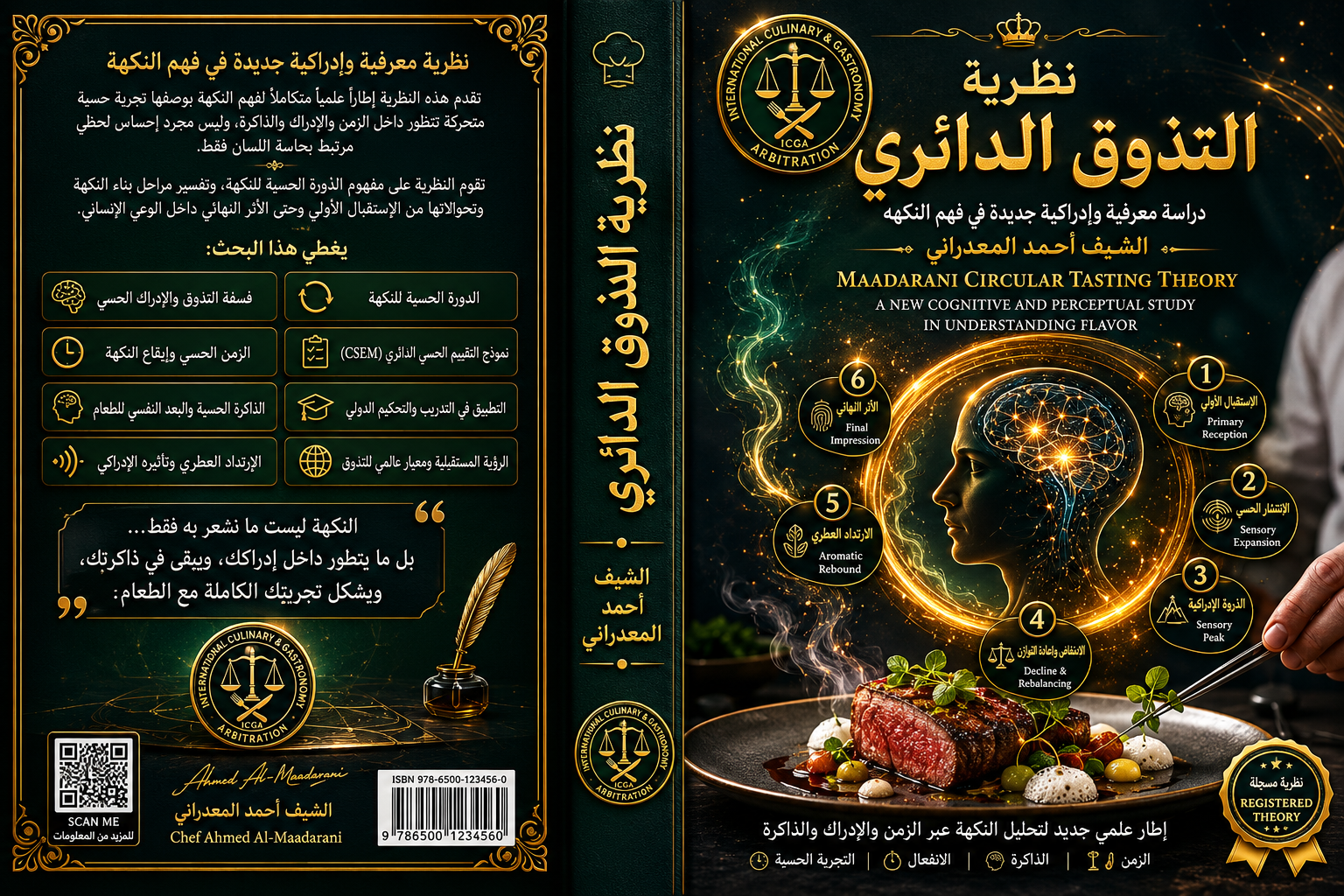
The theory holds that flavor is not a rigid entity, but a “perceptual movement” that changes continuously during tasting. Any attempt to fix taste or reduce it to a final description oversimplifies the nature of the sensory experience. True flavor is not understood in one moment. It is discovered gradually through time, like an idea, a piece of music, or an emotional experience whose layers unfold with continuity.
From this perspective, the theory introduces the concept of Living Flavor. This concept indicates that flavor possesses an internal dynamism that allows it to transform, develop, and reshape itself within perception. Good food does not present a single fixed taste. It creates a sensory path that interacts with the taster in a renewed way, as if flavor were a living entity moving and growing within awareness.
The theory also affirms that time is part of the philosophy of flavor itself. Some foods reveal their value quickly, while others require patience and contemplation in order to be understood properly. Tasting therefore becomes an act of reflection as much as an act of sensation, in which the taster participates in discovering the food rather than receiving it passively and directly.
In this context, Circular Tasting Theory considers that the true quality of food is not measured only by strength or complexity, but by its ability to create an “integrated perceptual journey.” A successful dish is not one that only impresses in the first moment. It is one that continues to develop inside awareness and leaves an effect that extends after tasting has ended.
The theory also redefines the idea of “ending” in the food experience. In traditional models, flavor ends when eating ends. The theory, however, considers the final effect part of flavor itself. The persistence of taste, aroma, or emotion within memory is an extension of the sensory cycle, not a separate stage.
Philosophically, tasting within this model becomes a kind of dialogue between the human being and food. Flavor is not imposed on the taster in a rigid form. It is shaped through interaction among matter, perception, memory, emotion, and time. Therefore, every tasting experience carries a unique character that cannot be reproduced absolutely.
Circular Tasting Theory thus establishes a vision that considers food a moving human experience that goes beyond nutrition, giving flavor a new philosophical dimension and making it part of the human understanding of senses, awareness, time, and meaning.
The Neural Structure of Circular Tasting
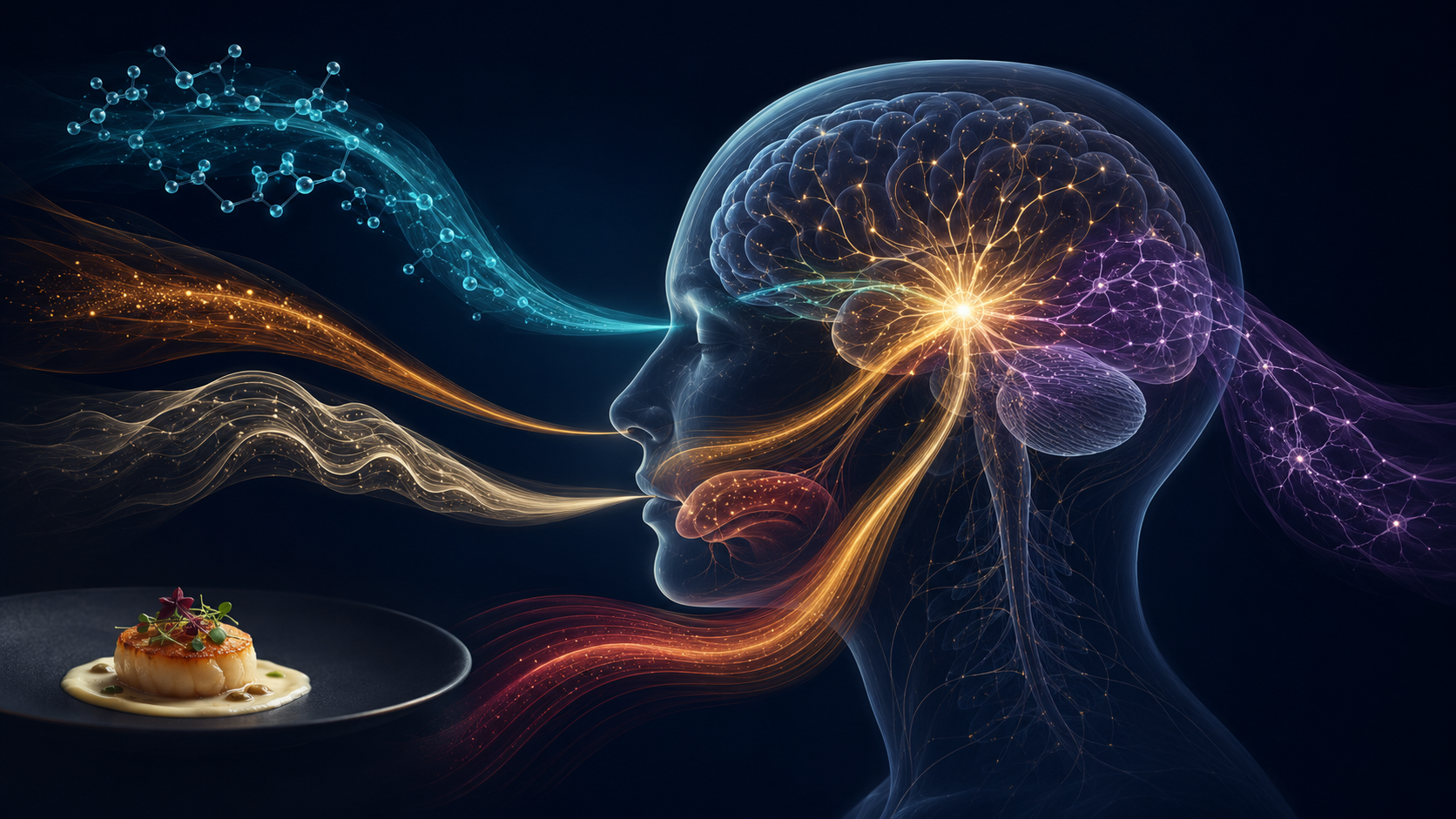
Circular Tasting Theory is based on understanding tasting as a complex neural process that is not limited to receiving sensory signals. It also includes analyzing those signals, reinterpreting them, and connecting them to memory, emotion, and time. From this standpoint, the brain does not operate as a passive receiver of food. It functions as an active system that continuously reconstructs flavor throughout the different stages of the sensory cycle.
When food enters the mouth, taste receptors begin sending electrical signals to the brain through the nervous system, where the basic taste of the food substance is analyzed. These signals, however, are not interpreted separately. They are integrated with other information coming from the olfactory system, texture, temperature, and even the psychological state of the taster. Through this integration, the “neural image of flavor” is formed within perception.
The theory proposes that the brain does not deal with flavor as a fixed signal, but as a changing process that passes through successive stages of analysis. At first, the basic elements of food are identified. Then higher neural centers begin reinterpreting the experience according to previous experiences, expectations, and psychological emotions. This leads to the development of sensory perception over time.
The theory introduces the concept of Neural Flavor Mapping. This refers to the way the brain organizes sensory signals and connects them within a single perceptual structure. Every flavor creates a particular neural pattern inside the brain, depending on the interaction of taste, aroma, memory, and emotion. The same food can therefore generate different responses in different people because their neural maps are shaped by different previous sensory experiences.
The theory also indicates that some stages of tasting occur after direct interaction with food has ended, especially during aromatic rebound and sensory reconstruction. In these moments, the brain continues processing remaining signals and recomposing the tasting experience. Flavor therefore continues within perception even after food has disappeared from the mouth.
This neural activity also explains the phenomenon of “delayed flavors,” in which the taster notices a new taste or sensation several seconds after tasting. This occurs because some sensory signals need more time to reach full awareness or to be integrated with the other elements of the food experience.
Neural connections also play an important role in constructing the final impression of food. The more varied and interconnected the sensory experience is, the greater the brain’s ability to remember and later recall it. Foods that pass through a rich and developing sensory cycle often leave a deeper effect in memory than foods with a direct and fixed taste.