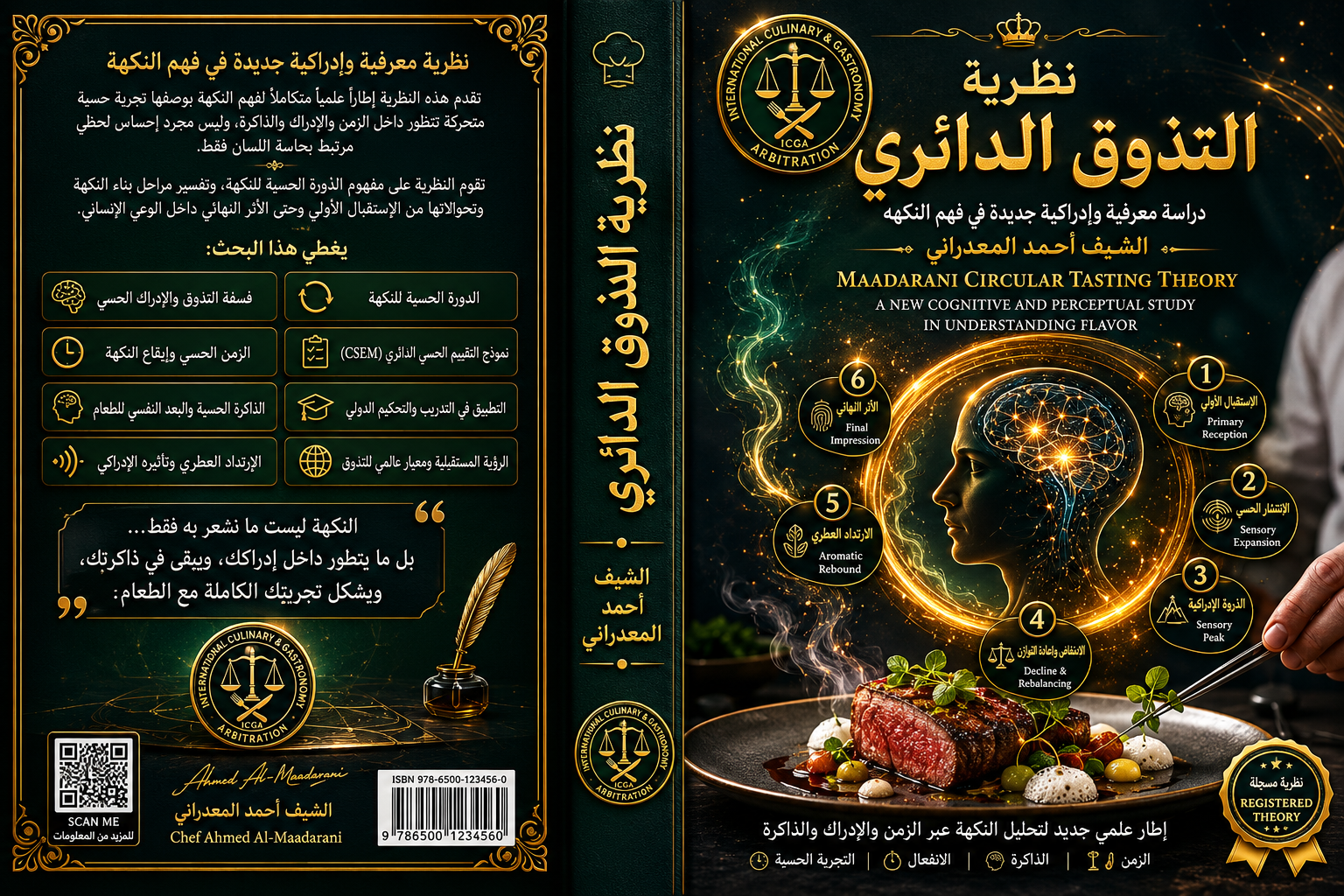
المعدراني، أحمد. (2026). نظرية التذوق الدائري: دراسة معرفية وإدراكية جديدة في فهم النكهة. IUOAMC Global Platform.
This type of balance appears clearly in multilayered foods such as complex sauces, fermented dishes, professional desserts, and specialty coffee, where sensory signals change gradually without making the taster feel a break or disturbance between the different stages of flavor.
Sensory balance is also linked to the speed of the food’s temporal development. Some dishes fail to achieve balance because they reveal their elements too forcefully at the beginning and then collapse quickly. Other dishes succeed in building a stable experience because they allow flavor to develop gradually without sharp sensory shocks or sudden transitions.
Food texture plays an important role in preserving this balance, as appropriate texture helps regulate the speed at which flavor is released inside the mouth. Temperature, moisture, fat ratio, and spices also influence the rhythm of the sensory cycle, making balance the result of a complex interaction among several elements rather than a simple chemical equilibrium.
From the perspective of circular tasting, loss of balance does not only mean a mistake in taste. It may also mean a disturbance in the “movement of flavor” itself. Ingredients may be good individually, yet their temporal appearance may be incoherent, creating a fragmented or perceptually tiring sensory experience.
For this reason, the theory considers that the true balance of food is measured by its ability to manage sensory transformations smoothly and to preserve the connection of the perceptual cycle from beginning to final trace, so that the taster feels that all stages of flavor belong to one integrated experience rather than to separate or competing signals.
Psychological Emotion and Its Influence on the Sensory Cycle
Tasting cannot be understood as a purely biological process, because the food experience is deeply connected to the psychological and emotional state of the human being. For this reason, Circular Tasting Theory considers psychological emotion not as an external factor that affects food secondarily, but as a fundamental part of the sensory cycle itself. Flavor interacts with feelings, memories, and expectations to shape the taster’s final experience.
When a person eats a particular food, he or she does not respond only to chemical signals coming from the tongue and nose. The brain places these signals within a broader emotional and psychological context. Food may evoke comfort, nostalgia, joy, or aversion. Some flavors may be connected to previous experiences that make their effect stronger or weaker than their direct physical reality.
Flavor is therefore not perceived in a completely neutral way. It always passes through the taster’s “psychological filter.” This explains why judgment of the same dish may differ according to mood, environment, or personal experience, even when the food’s components remain unchanged.
The theory proposes the concept of Emotional Flavor Response. This is the stage in which flavor shifts from a sensory feeling into an emotional experience connected to the inner awareness of the human being. At this stage, food becomes capable of activating complete psychological states, and the value of flavor may increase because of its association with reassurance, memory, identity, or belonging.
Psychological state also affects the speed of the sensory cycle itself. A calm and focused taster is often able to notice deeper and more complex flavor layers. Psychological tension or mental distraction, however, reduces the ability to follow the subtle transformations of food. Thus, the quality of tasting depends not only on the quality of the dish, but also on the perceptual state of the taster.
In some highly professional food designs, psychological effect is deliberately used within the construction of the sensory experience. Certain aromas may be used to create warmth, specific colors may strengthen the sense of freshness, and carefully controlled temperatures may evoke comfort or surprise. In such cases, food becomes closer to an “integrated emotional experience” than to a mere food substance.
Circular Tasting Theory also observes that psychological emotion becomes more influential in the later stages of the sensory cycle, especially during aromatic rebound and the final aftereffect. In these moments, the brain begins to reinterpret the experience more deeply, allowing flavor to become a memory or a long-lasting sensation that goes beyond the immediate moment.
Interestingly, the value of some foods is not measured only by the strength of taste, but by their ability to create a lasting psychological effect. A dish may be technically simple yet leave a profound emotional impact because of its connection to feelings, cultural identity, or the human meaning associated with it.
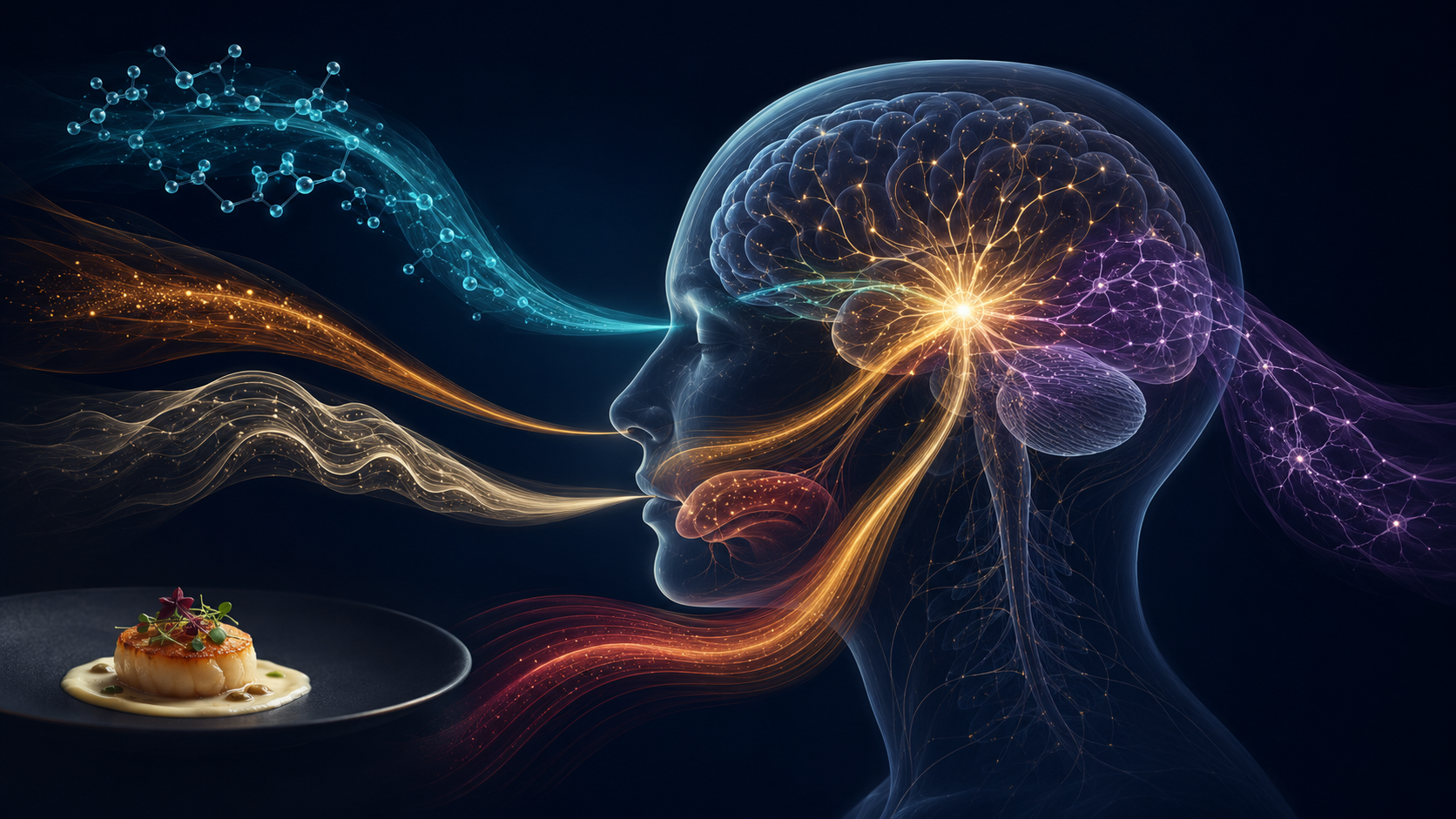
Thus, the theory affirms that true tasting does not occur in the tongue alone. It occurs within a complex system in which physical sensation, psychological emotion, memory, and awareness intersect, transforming flavor into an integrated human experience that moves through mind, feeling, and time at once.
The Philosophy of Flavor in Circular Tasting Theory
Circular Tasting Theory does not view flavor as a mere chemical result of the interaction between food and the senses. Rather, it considers flavor a perceptual and philosophical phenomenon that expresses the deep relationship between human beings and the food experience. According to this view, flavor is not a fixed thing that can be reduced to a simple sensory equation. It is a changing experience that carries temporal, psychological, and cultural dimensions extending beyond the material substance itself.