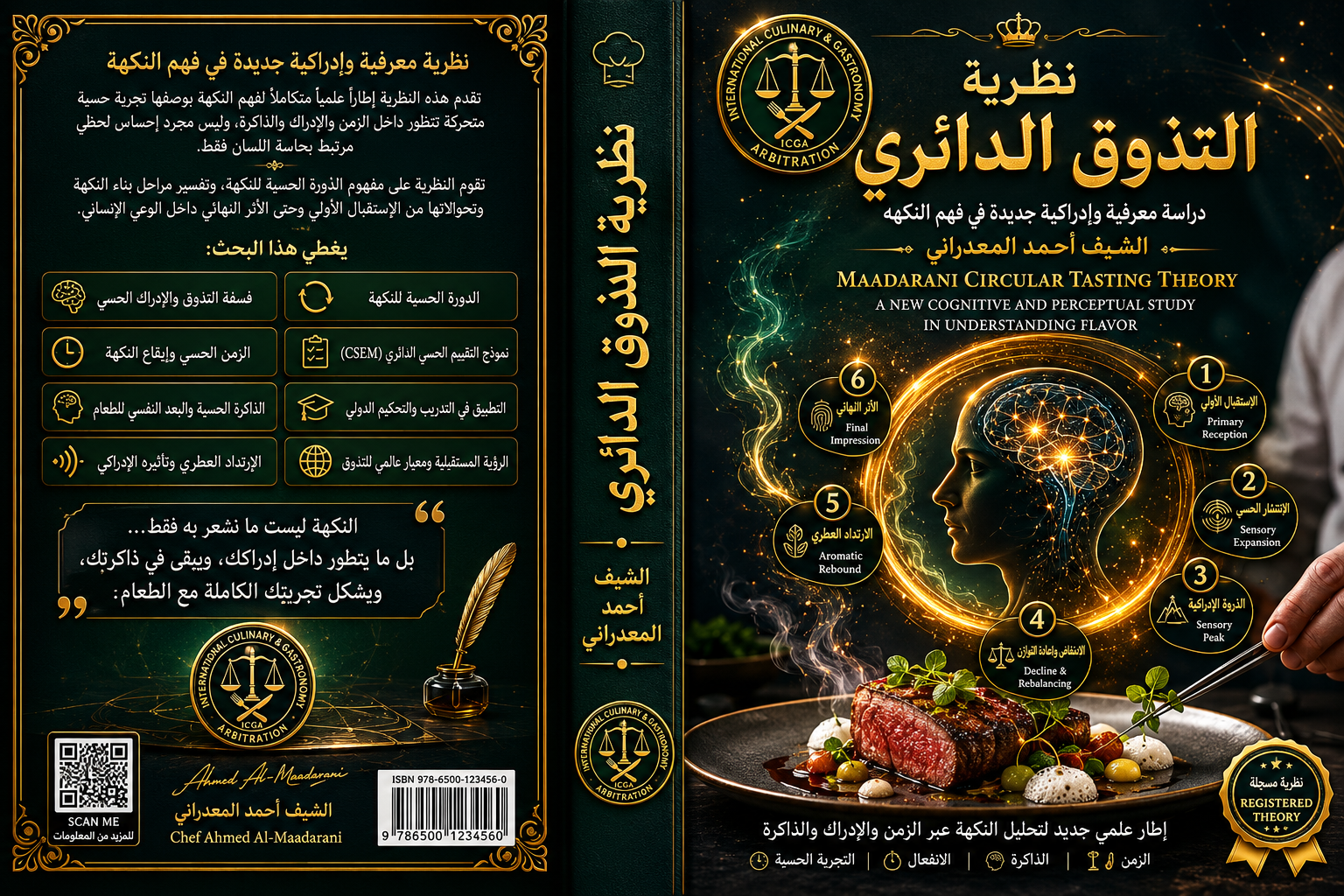
المعدراني، أحمد. (2026). نظرية التذوق الدائري: دراسة معرفية وإدراكية جديدة في فهم النكهة. IUOAMC Global Platform.
From the perspective of circular tasting, aromatic rebound is not a secondary phenomenon. It is a fundamental stage within the complete flavor cycle. Some dishes are intentionally designed to produce a long-lasting delayed effect, so that the experience continues inside perception after eating has ended. In this case, the “remaining trace” becomes part of the dish’s identity and professional quality.
Sensory return is also closely connected to memory and psychological emotion. When flavor returns after a moment of apparent disappearance, the brain begins connecting it more deeply with feelings and previous experiences. This gives food a stronger ability to leave a lasting imprint within human sensory awareness.
Through this phenomenon, Circular Tasting Theory affirms that flavor is not merely a taste that is consumed and then finished. It is an experience that moves through time, returns in multiple ways, and continues to reshape itself within human perception even after the apparent moment of tasting has ended.
Sensory Peak and Flavor Transformation
During the circular tasting cycle, flavor reaches a stage known as the “sensory peak.” This is the moment when the tasting experience reaches its highest degree of perceptual clarity and integration. At this stage, different sensory elements—taste, aroma, heat, texture, and psychological emotion—gather within a concentrated perceptual point, giving the taster an intensified awareness of the food’s specificity and true identity.
However, in Circular Tasting Theory, the peak is not understood as a fixed or identical point in all foods. It is a changing stage that differs from one dish to another according to its chemical, sensory, and temporal composition. Some foods reach their peak quickly and then decline immediately, while others build their peak gradually through successive layers of flavor, making the experience deeper and more complex.
In many cases, the peak is not linked to the strongest direct taste, but to the highest level of sensory harmony among the components of the dish. The flavor may be strong at first yet unbalanced, then gradually transform into a more stable and richer state as the sensory cycle develops. The peak is therefore not measured only by intensity, but by the degree of perceptual integration that flavor achieves.
The theory introduces the concept of Flavor Transformation. This refers to the changes that occur within the tasting experience as food moves from one stage to another. Some flavors may begin sweet and then transform into warm, smoky, or acidic sensations. Some ingredients reveal their true character only after a certain time has passed or after they have mixed with saliva, heat, and breathing.
This transformation is one of the most important elements of excellence in modern professional kitchens. The goal is no longer simply to produce a fixed flavor, but to design a “sensory journey” in which the experience changes in a deliberate manner. Many fine dishes therefore depend on the temporal gradation of flavors, allowing the taster to discover new layers as tasting continues instead of receiving one repeated sensation.
The sensory peak is also connected to complex psychological and perceptual factors. Some foods create a state of anticipation before reaching the peak, which increases their psychological effect when they fully appear. In contrast, some foods lose their value quickly because they reveal everything from the beginning without any later sensory development.
It is also notable that the peak may not be singular within the same dish. Some foods can pass through several successive peaks. A taste-related peak may appear first, followed by an aromatic peak, and then by a thermal or emotional peak at the end. This multiplicity of perceptual summits is one of the most prominent manifestations of sensory complexity in circular tasting.
Accordingly, the theory considers that the quality of food is not determined only by the direct taste it provides, but by its ability to manage sensory transformations over time and create a developing, rising experience that maintains perceptual attention until the end of the flavor cycle.
Sensory Balance Within the Circular Cycle
Sensory balance is one of the most important elements that determine the quality of the food experience in Circular Tasting Theory. However, the concept of balance here differs from the traditional understanding that links it only to equal distribution or immediate harmony among flavors. In this model, balance does not mean stability. Rather, it means the ability of flavor to maintain harmony while transforming and moving through time.
In traditional tasting, balance is often measured by comparing basic taste elements such as sweetness, acidity, bitterness, and saltiness. A good dish is understood as one in which no flavor dominates another in an unpleasant way. Yet this concept remains limited because it treats flavor as a static state, while Circular Tasting Theory sees flavor as passing through continuous transformations during which the center of balance may shift more than once.
A dish may begin with a clear acidic sensation, then gradually recede to reveal fatty warmth, aromatic depth, or a delayed sweet trace. The experience can still remain balanced because these transformations occur within an organized and deliberate path. True balance therefore becomes “balance of movement,” not balance of stillness.
The theory introduces the concept of Dynamic Sensory Balance. This refers to the ability of flavor to move between different stages without losing perceptual harmony. Refined foods do not present one continuous taste. They build a sequence of transformations through which the taster feels that the experience is developing naturally and coherently.