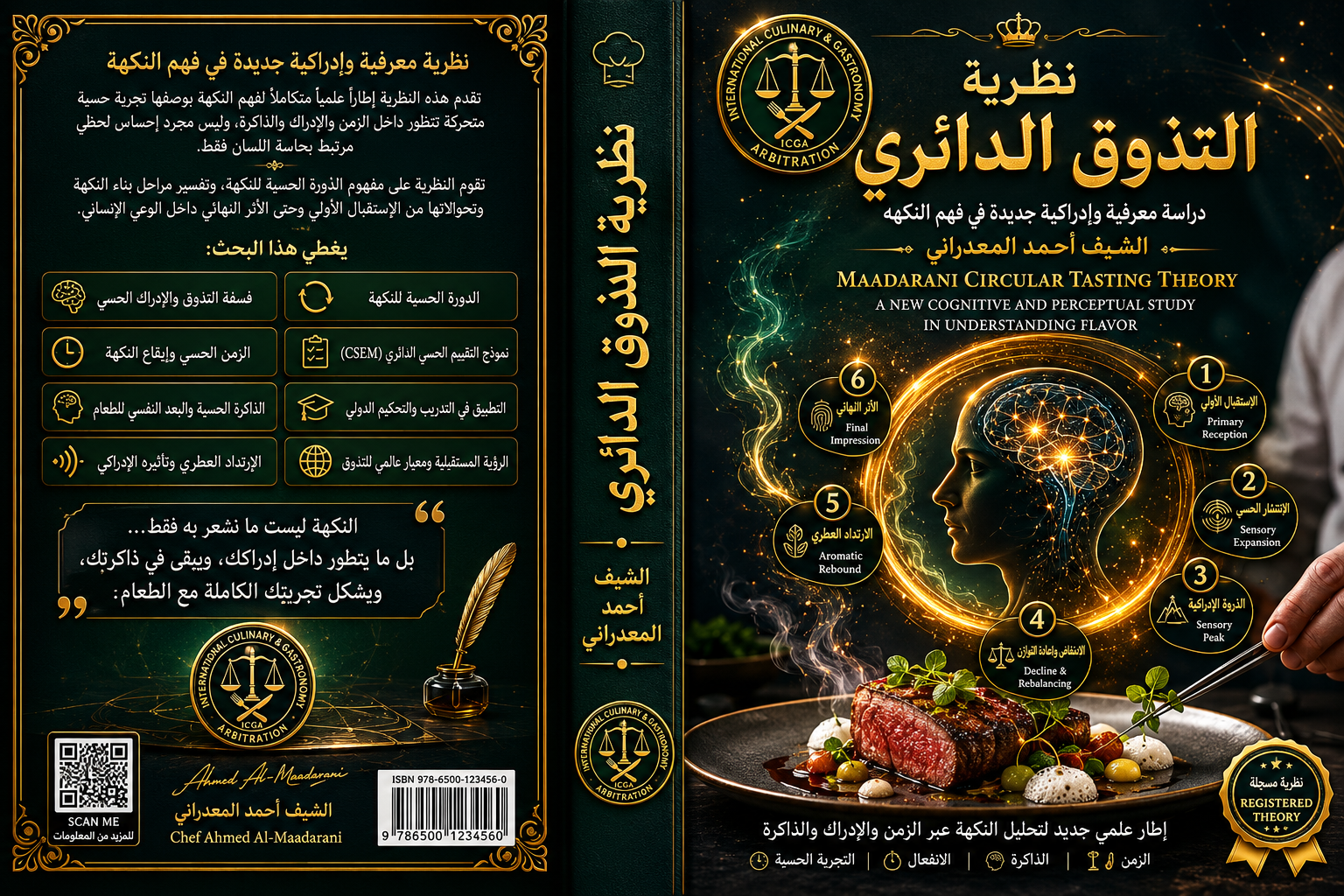
المعدراني، أحمد. (2026). نظرية التذوق الدائري: دراسة معرفية وإدراكية جديدة في فهم النكهة. IUOAMC Global Platform.
The traditional understanding of taste depends on dividing flavors into familiar elements such as sweetness, bitterness, acidity, saltiness, and umami. These elements are often treated as independent signals that can be measured directly. Yet the real experience of food reveals that human beings do not perceive flavors with such simplicity. Instead, they experience successive transformations in which the strength, direction, and psychological effect of taste change within seconds or minutes.
From this comes the idea of the “sensory movement of flavor.” Flavor is not considered a fixed point, but a perceptual path moving within the tasting experience. It may begin with a simple sensation and then gradually expand to reveal more complex layers. Some effects may disappear and later return in a different form through retronasal aroma, thermal aftereffect, or sensory memory.
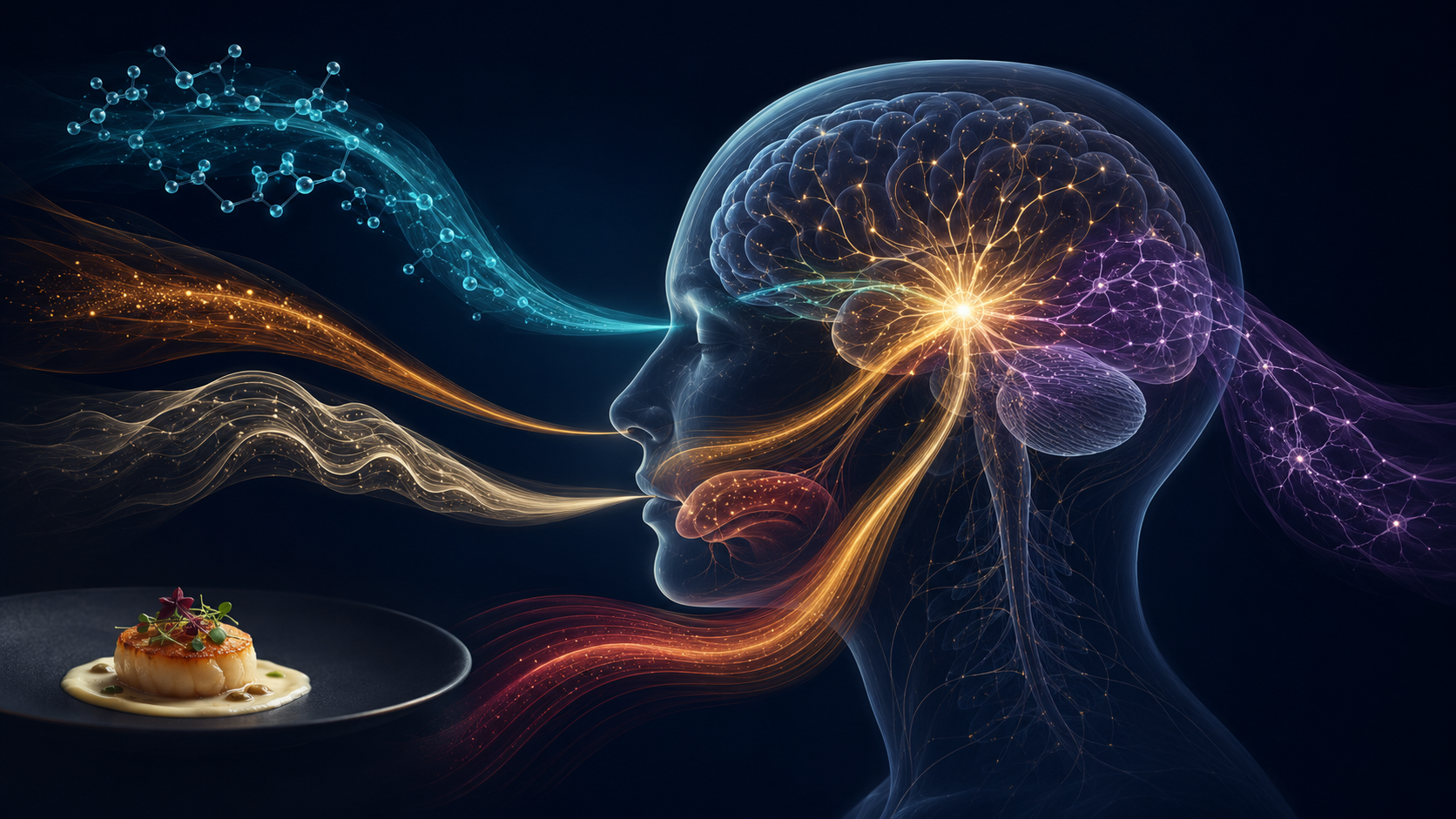
Circular tasting is grounded in the principle that food perception does not occur in one organ alone. It results from simultaneous interaction among several sensory systems. The tongue captures basic chemical signals; the olfactory system analyzes aromatic compounds; and the brain integrates these inputs with memory, psychological emotion, and previous experiences. Through this integration, the “final image of flavor” is formed within the taster’s awareness.
The theory also introduces the idea that food possesses an “internal temporal structure,” meaning that some flavors require a specific amount of time before they appear or reach their peak. Some foods have a fast effect and disappear quickly, while others build slowly and become more complex as tasting continues. This temporal difference is part of the identity of the dish, not merely a secondary phenomenon.
In this context, circular tasting rejects the idea of immediate absolute judgment. It considers that true evaluation of food must include the entire sensory cycle through which flavor passes. Judging a complex dish within a few seconds may lead to ignoring its deeper perceptual stages, especially in foods that depend on fermentation, thermal gradation, or multiple aromatic layers.
This vision establishes a qualitative shift in the understanding of tasting. Food changes from “matter that is consumed” into “an experience that is lived,” and flavor becomes a changing perceptual event that moves through time and awareness, giving modern culinary science a deeper and more complex philosophical and sensory dimension.
Traditional Tasting vs Circular Tasting
Most traditional schools of tasting have historically relied on the principle of “direct response,” in which food is evaluated according to the first impression it leaves in the mouth. This approach assumes that the quality of a dish can be determined quickly through the strength of taste, flavor balance, and direct sensory clarity. Although this method remains useful for the basic evaluation of food, it is limited when dealing with complex food structures or dishes whose flavors develop over time.
In traditional tasting, flavor is viewed as a relatively fixed state. Food is considered good or bad from the first moment. Therefore, focus is placed on the immediate response of the tongue, while many changes that occur later during chewing, after swallowing, or through retronasal breathing are neglected. This model also tends to reduce the tasting experience to a set of quick judgments that may not reflect the true depth of the food.
Circular tasting differs fundamentally from this view because it regards flavor as a moving and changing process that passes through several perceptual stages. According to this model, flavor is not measured only by what happens at the beginning, but by what happens throughout the full sensory journey of food. Time therefore becomes an essential element in analysis, and the food experience changes from a separate moment into an ongoing perceptual path.
In the traditional model, the main focus is on the visible taste. Circular tasting, however, also gives importance to what may be called “delayed flavors” or “feedback responses.” The real effect of some ingredients may appear after several seconds, or aromas may return more strongly after swallowing through retronasal breathing. These phenomena cannot be understood within a traditional linear model of tasting.
Traditional tasting also often separates the senses, treating taste, aroma, and texture as independent elements. Circular tasting, by contrast, considers all these elements as moving within a single perceptual system. Aroma may change the interpretation of taste; heat may influence aromatic perception; texture may slow or accelerate the appearance of flavor. Thus, the sensory experience is an interconnected network rather than a collection of separate signals.
Another key difference is that traditional tasting focuses on the “stability of flavor,” whereas circular tasting focuses on the “transformation of flavor.” Some refined foods are not intended to offer a single stable taste, but to create a sensory journey in which sensations change gradually and deliberately. This concept is especially clear in modern cuisines that rely on aromatic layering, fermentation, thermal interaction, and sensory gradation.
Circular tasting can therefore be understood as an attempt to expand the limits of traditional sensory analysis by moving from the idea of “momentary taste” to the idea of the “temporal movement of flavor.” This shift may reshape future approaches to evaluation, judging, and the understanding of the food experience.
The Temporal Structure of Flavor