المعدراني، أحمد. (2026). نظرية التذوق الدائري: دراسة معرفية وإدراكية جديدة في فهم النكهة. IUOAMC Global Platform.
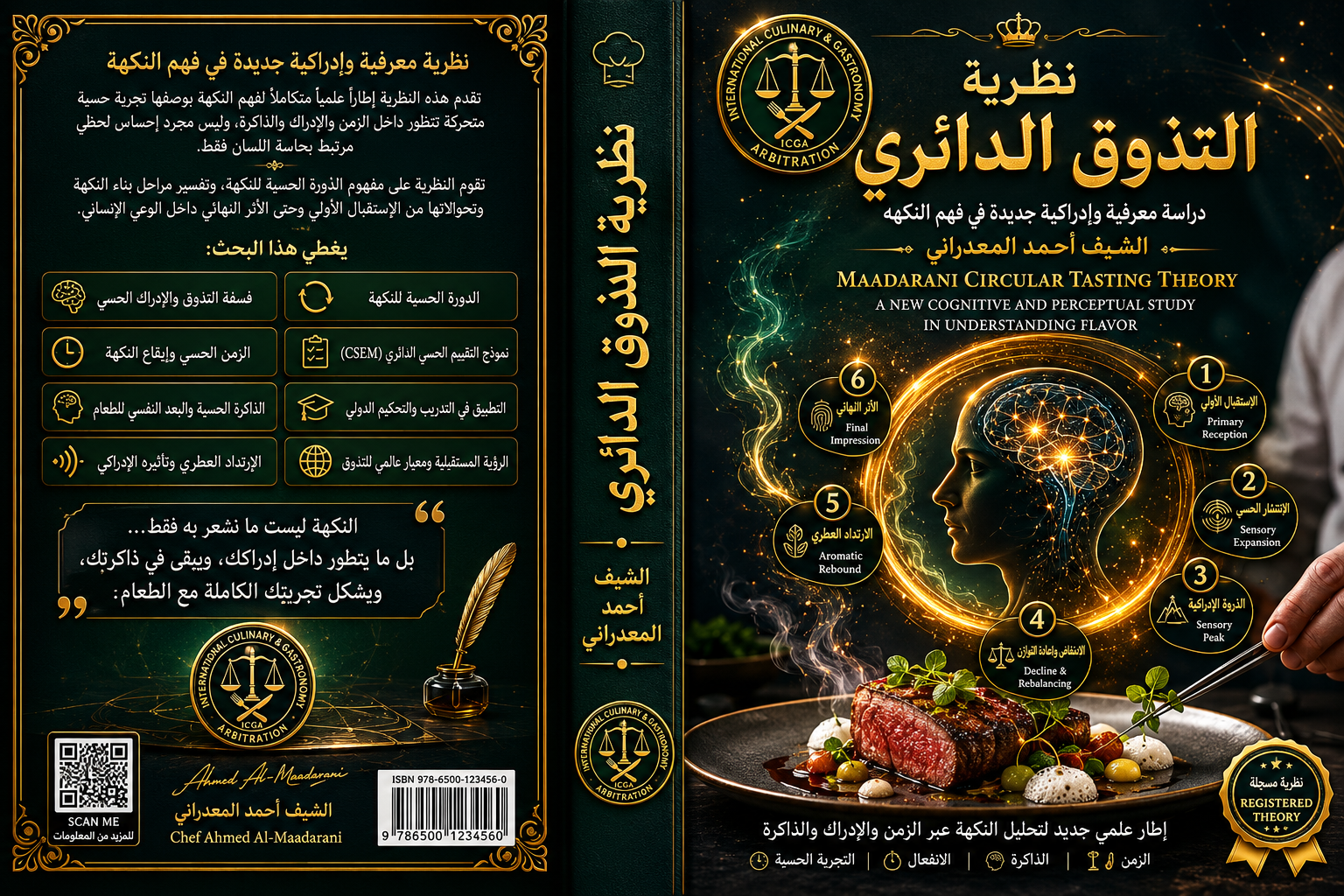
The study shows that flavor is not born in one moment. It is built gradually through a cycle that includes primary reception, sensory expansion, perceptual peak, gradual decline, aromatic rebound, and final effect. Each of these stages has an independent value within the complete food experience.
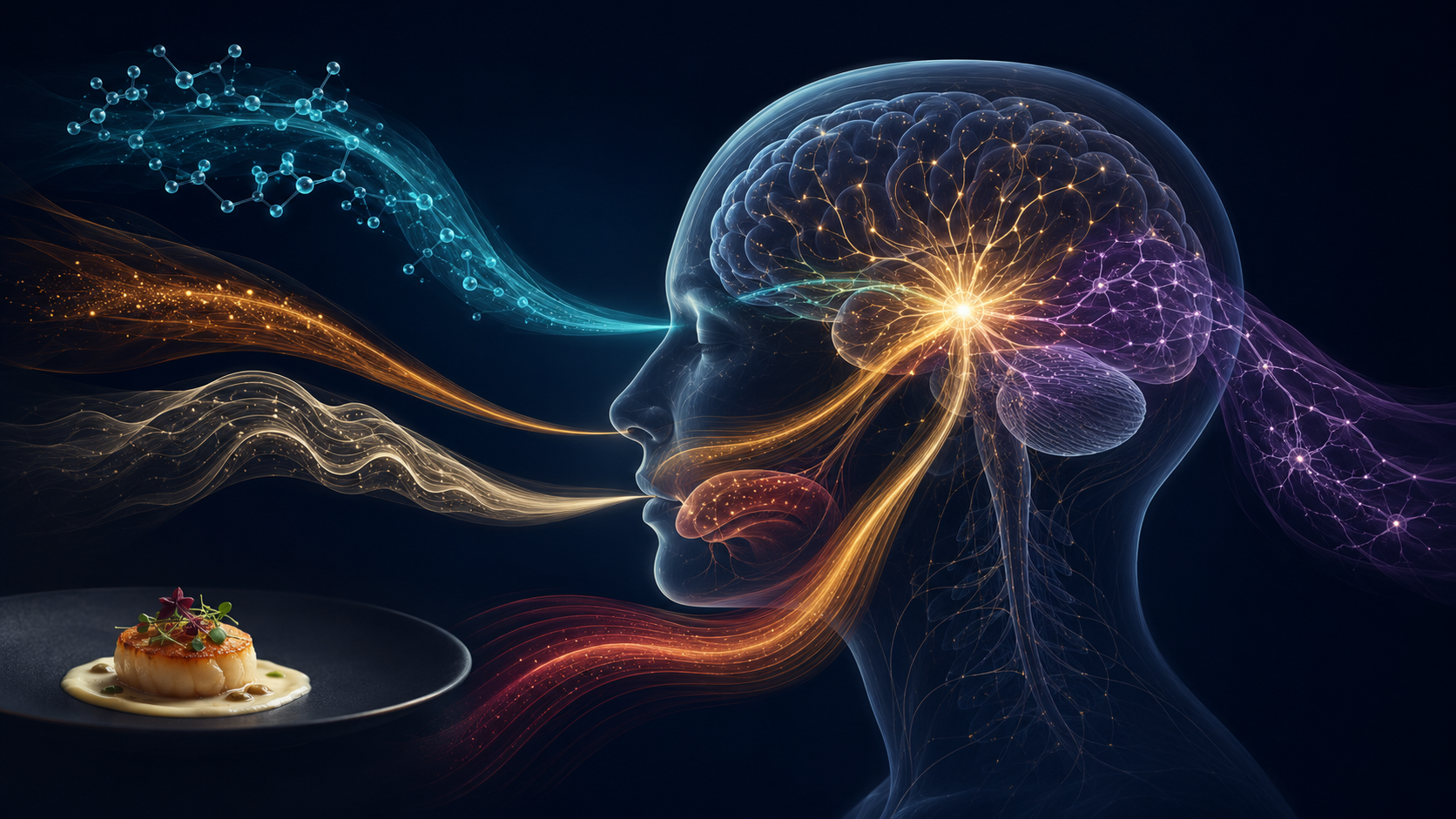
The theory also clarifies that time is not merely an external framework for tasting, but an internal element in flavor formation itself. Food possesses a “perceptual movement” that changes with heat, breathing, texture, memory, and psychological emotion. True tasting therefore cannot be reduced to first impression or direct taste strength alone.
Through the concept of the “sensory cycle of flavor,” the theory offers a new explanation for several perceptual phenomena connected to food, such as delayed flavors, aromatic rebound, sensory memory, perceptual persistence, and temporal transformations of taste. These elements have long existed in professional tasting practice, but they have not previously been gathered within a unified and integrated theoretical framework.
The Circular Sensory Evaluation Model (CSEM) also represents a practical application of the theory. It provides an analytical system that allows flavor to be studied through the complete sensory cycle rather than through momentary evaluation. The theory can therefore be used in culinary judging, taster training, fine dining development, sensory experience design, modern culinary education, and the analysis of refined food products.
The study also shows that the future of culinary science will increasingly move toward understanding the relationship between food and human perception. The value of a dish will not be linked only to its ingredients, but to its ability to create a balanced sensory journey, stable psychological effect, long-lasting flavor memory, and distinctive perceptual identity.
The theory further affirms that the modern chef is no longer merely an executor of recipes. The chef has become a “perceptual engineer” who designs the sensory time of food and controls the movement of flavor within awareness, memory, and emotion.
Philosophically, Circular Tasting Theory reopens a fundamental question about the nature of food itself. Eating is no longer understood as only a biological act, but as a deep human experience in which the senses, time, memory, emotion, cultural identity, and neural perception interact. Food thus becomes a complex sensory language that expresses the human being as much as it nourishes him.
In light of the above, Circular Tasting Theory can be considered a foundational step toward a new school in modern tasting sciences. This school studies flavor as a dynamic and multidimensional experience and opens the way to deeper systems in sensory analysis, judging, education, and academic research.
The theory therefore does not end with explaining flavor. It begins a new journey toward understanding the relationship among human beings, food, time, and perception, in an attempt to rebuild tasting as one of the most complex and rich human experiences.
Final Recommendations and Future Vision
In light of the comprehensive reinterpretation of flavor and tasting offered by Circular Tasting Theory, there is a need to develop new scientific and professional paths based on understanding sensory perception as a moving temporal process rather than as a momentary response to food. The study therefore presents a set of recommendations that can form a foundation for the future of modern tasting sciences.
The first recommendation is the need to rebuild culinary education curricula so that they include temporal flavor analysis, the study of sensory rhythm, understanding of aromatic memory, analysis of perceptual transformations, and training in advanced sensory awareness. This would prepare a new generation of chefs and tasters capable of understanding food more deeply and comprehensively.
The theory also recommends adopting the Circular Sensory Evaluation Model (CSEM) in international judging programs, fine dining, quality analysis, sensory training, and professional tasting, because it provides a more precise framework for evaluating the complete flavor cycle instead of relying only on first impression.
The study also recommends establishing Circular Sensory Research Centers. These specialized centers would study the sensory time of food, the relationship between perception and flavor, aromatic rebound, taste memory, the psychological effect of food, and neural analysis of tasting, allowing culinary sciences to develop within a more advanced research framework.
The theory further proposes the development of new academic programs in food perception, flavor philosophy, temporal sensory analysis, neurogastronomy, and sensory experience engineering, so that tasting sciences become a multidisciplinary field combining cooking, psychology, neural perception, and sensory philosophy.
Professionally, the study recommends developing certifications, training laboratories, new judging systems, sensory analysis maps, and databases of flavor cycles, all based on the principles of circular tasting.
The theory holds that the future of fine kitchens will move toward designing Multi-Layered Sensory Experiences, where the aim of food is to create a perceptual journey, build a psychological effect, design sensory memory, and control the temporal rhythm of flavor, not merely to present good taste or luxurious ingredients.
The study also recommends integrating modern technology with sensory analysis, especially in the fields of artificial intelligence, sensory data analysis, tracking of perceptual response, and temporal flavor mapping, in order to build future systems that are more precise in understanding the relationship between human beings and food.