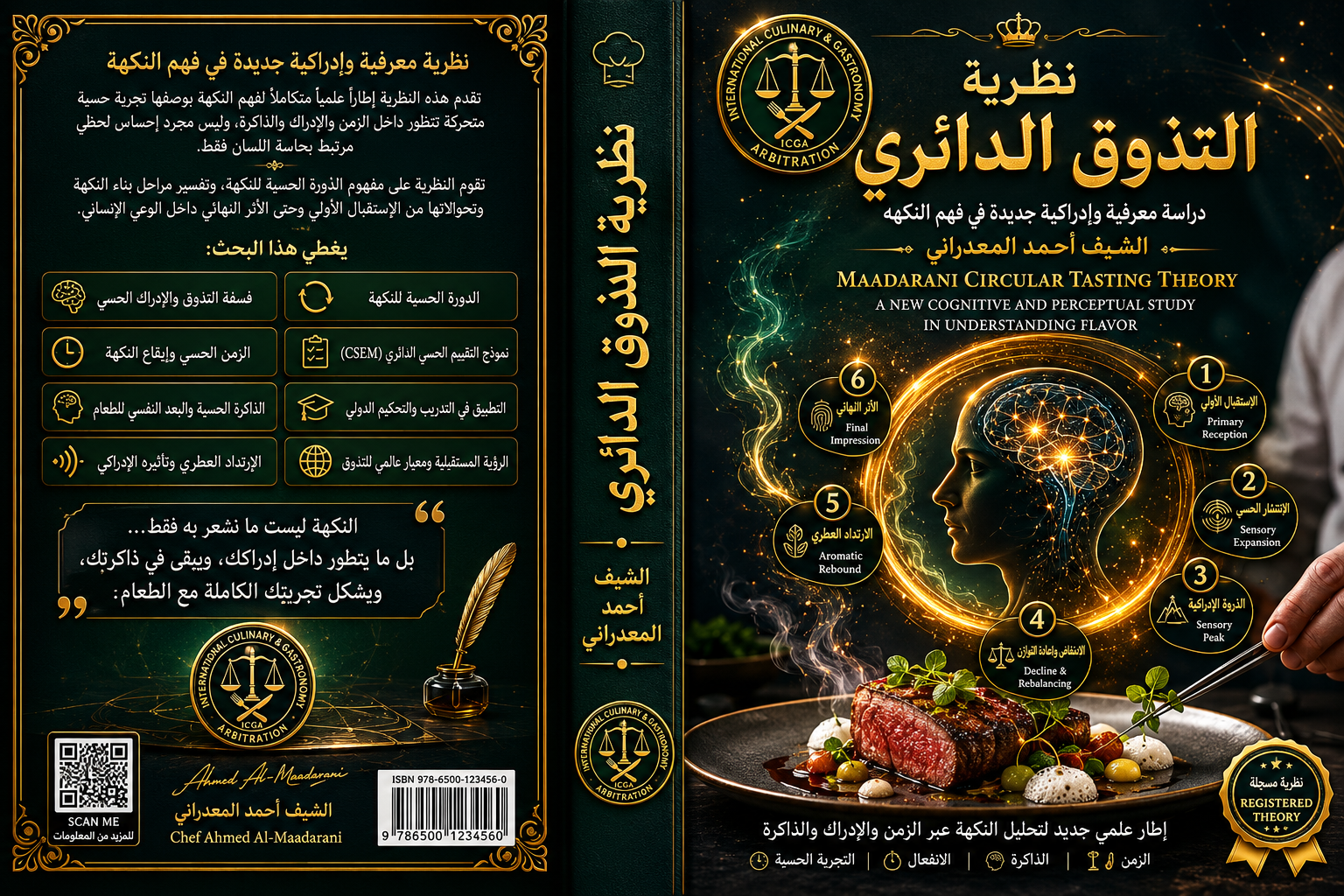
المعدراني، أحمد. (2026). نظرية التذوق الدائري: دراسة معرفية وإدراكية جديدة في فهم النكهة. IUOAMC Global Platform.
Thus, CSEM forms an integrated professional framework for analyzing food. Flavor changes from an element described generally into an experience that can be studied, deconstructed, and analyzed according to advanced temporal and perceptual criteria.
Using the CSEM Model in Training and International Judging
Through the CSEM model, Circular Tasting Theory opens the way for developing new methods in training chefs, judges, and professional tasters. Tasting moves from being a skill based only on impression and personal experience into an organized analytical system based on understanding the complete sensory cycle of food.
In traditional training systems, focus is often placed on distinguishing flavors, describing taste, identifying basic defects, and evaluating direct balance. CSEM adds a deeper dimension by training the taster to “read the temporal movement of flavor” and analyze how it develops, transforms, and stabilizes within perception.
The theory uses the concept of Advanced Sensory Interpretation. This refers to the professional’s ability to understand the internal relationships among time, aroma, taste, texture, sensory rhythm, memory, and psychological emotion, rather than merely describing flavor superficially or directly.
The model can also be used to design professional training programs that divide sensory skills into stages. Trainees learn to analyze the perceptual beginning, observe sensory expansion, identify the peak, understand gradual decline, analyze aromatic rebound, and evaluate the final effect and sensory identity. This allows the formation of tasters who are more precise, aware, and capable of understanding the temporal transformations of food.
In international judging, CSEM offers the possibility of developing more fair and professional evaluation systems. Judgment is no longer based only on rapid impression or personal taste, but on organized analysis of the complete sensory cycle.
The model also helps reduce common problems in traditional judging, such as rushing to issue judgments, overemphasis on the beginning, neglect of final effect, disregard for delayed flavors, and weak analysis of sensory persistence.
By adopting CSEM, a judge becomes able to evaluate flavor stability, quality of transformations, temporal harmony, strength of aromatic rebound, and continuity of perceptual effect—elements often absent from traditional evaluation systems.
Circular Tasting Theory also proposes the creation of Circular Sensory Training Labs. These are specialized training environments aimed at developing sensory attention, temporal awareness of flavor, the ability to analyze layers, the recognition of subtle transformations, and the measurement of the perceptual effect of food.
These laboratories can be used within culinary academies, judging programs, fine dining courses, and sensory research centers. Professional certifications based on the theory can also be developed, such as Circular Tasting Analyst, Perceptual Flavor Judge, Specialist in Temporal Sensory Analysis, and Sensory Cycle Evaluation Expert. Such certifications would open a new field of professional specialization within modern culinary arts.
Circular Tasting Theory holds that the future of sensory education and judging will move toward integrating cognitive science, neural analysis, food psychology, temporal flavor analysis, and artificial intelligence technologies in order to build more precise systems for understanding the relationship between food and human perception.
CSEM is therefore not merely an evaluation tool. It is an integrated educational and judging platform that can help establish a new generation of judges and tasters capable of understanding flavor as a moving, multidimensional perceptual experience, not merely as a momentary sensation of taste.
Toward a Global Standard for Circular Tasting
With the development of modern culinary sciences and the growing need for more precise and deeper evaluation systems, Circular Tasting Theory proposes the possibility of building a new global standard for flavor analysis based on understanding the complete sensory cycle of food. This standard would move from traditional momentary evaluation toward the analysis of flavor as an integrated temporal and perceptual experience.
In current traditional systems, methods of tasting and judging differ greatly among institutions, schools, and global kitchens. Judgments often depend more on personal experience and individual impression than on a unified analytical framework. Circular Tasting Theory, however, proposes building a global sensory language based on the stages of the perceptual flavor cycle as a shared reference for analysis and evaluation.
The theory uses the concept of Global Circular Sensory Framework. This is a system that aims to unify the understanding and analysis of flavor according to criteria based on sensory time, perceptual transformations, aromatic rebound, sensory persistence, flavor identity, and temporal balance, rather than focusing only on direct taste or momentary evaluation.
This framework can form the basis for developing international judging systems, professional training protocols, academic programs, fine dining evaluation standards, and modern sensory analysis methods. It would allow a more unified and professional understanding of tasting at the global level.
Circular Tasting Theory holds that the success of any global standard must depend on understanding the human being as a perceptual entity, not only as a taster of flavor. Modern evaluation must therefore include psychological effect, sensory memory, perceptual rhythm, flavor development, interaction among the senses, and stability of the final effect—elements often neglected in traditional models.
The theory also proposes the possibility of developing a Circular Flavor Profiling System. This system would allow the analysis and documentation of the “sensory personality” of foods and products by recording the shape of the sensory cycle, the speed of transformations, the type of peak, the nature of aromatic rebound, the strength of persistence, and perceptual depth. Each dish or product would thus have a “perceptual signature” that could be studied, compared, and analyzed scientifically.