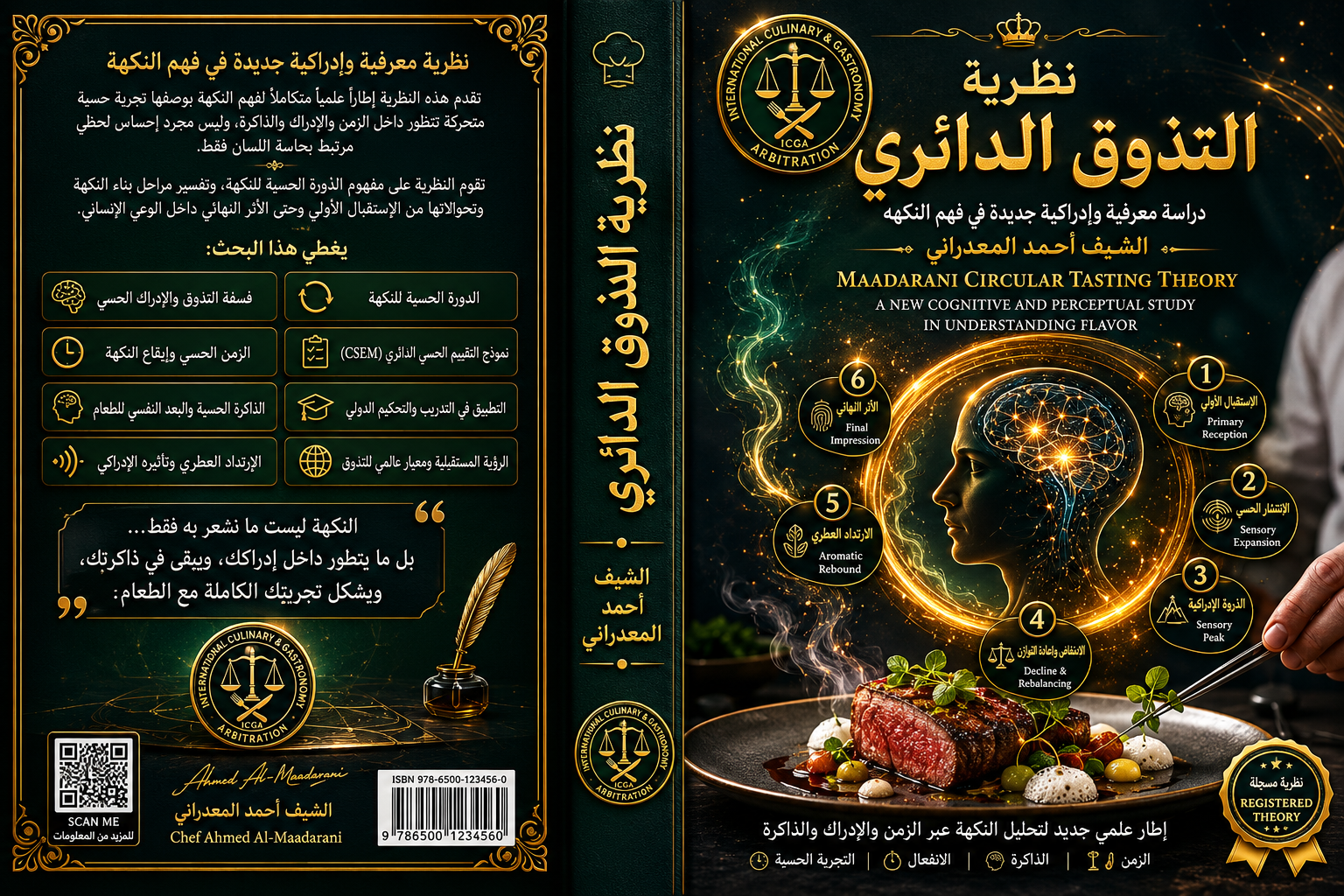
المعدراني، أحمد. (2026). نظرية التذوق الدائري: دراسة معرفية وإدراكية جديدة في فهم النكهة. IUOAMC Global Platform.
The next stage is the analysis of the perceptual peak. The taster is asked to notice the moment when flavor reaches its highest clarity, the nature of sensory integration, the resulting psychological emotion, and the quality of balance during the peak. It is also recorded whether the peak is gradual, sudden, stable, short, or extended, because all these factors affect the quality of the sensory cycle.
After the peak, Sensory Decline Mapping begins. In this stage, the taster observes how flavor recedes, how the ending stabilizes, which aromatic layers remain, and what delayed transformations appear.
Evaluation then moves to aromatic rebound, one of the most important stages of the model. The taster is asked to pay attention to the return of aromas through retronasal breathing, the continuity of perceptual effect, the emergence of new flavors after swallowing, and the strength of delayed aromatic presence.
Finally, Final Cognitive Impression is evaluated. At this stage, the analysis focuses on how long flavor remains in memory, the strength of psychological effect, the clarity of the food’s sensory identity, and the overall harmony of the cycle.
The model also allows the use of “sensory maps” to record flavor movement over time. Flavor intensity, peak timing, length of aromatic rebound, and stability of final effect can be represented visually along a temporal path, helping analyze the quality of the food experience more scientifically.
Circular Tasting Theory holds that this model can later be developed into an international judging system, an academic tool, a standard for fine dining analysis, a professional training method, and a foundation for food-perception research. It can also be integrated with artificial intelligence and sensory data analysis to build more precise future systems.
Thus, CSEM offers a new way to analyze food, based on understanding flavor as a moving perceptual journey rather than a momentary response to taste. It opens the door to a deeper and more professional level in modern tasting sciences.
Core Criteria in the CSEM Model
The Circular Sensory Evaluation Model (CSEM) relies on a set of core criteria designed to analyze the quality of the food’s sensory cycle in a comprehensive and balanced way. These criteria do not focus only on direct taste. They focus on how flavor moves through time and perception and on the food’s ability to build a connected and stable sensory experience.
Circular Tasting Theory holds that any professional evaluation must include the following elements as interconnected parts of the complete food experience.
First: Primary Sensory Clarity. This means the quality of the first impression, the clarity of basic taste, early balance, and purity of sensory entry. A professional dish should have a clear and readable beginning without perceptual disorder or confusion.
Second: Flavor Development. This includes the emergence of secondary layers, perceptual expansion, internal movement of flavor, and gradual transition between stages. This criterion is one of the most important indicators of the sensory depth of food.
Third: Perceptual Integration. This measures the harmony among taste, aroma, texture, and heat, as well as the connection among sensory elements and the unity of the perceptual experience. Professional flavor is not a collection of separate signals; it is an integrated and flowing experience.
Fourth: Sensory Peak Quality. This includes the strength of the peak, its balance, psychological effect, and stability within the cycle. The peak is not measured by intensity alone, but by its ability to integrate naturally within the complete sensory path.
Fifth: Temporal Balance. This is one of the most important criteria of the theory. It measures cycle speed, stability of transformations, absence of flavor collapse after the peak, and harmony between beginning and ending. Professional flavor must move fluidly through time without disturbance or interruption.
Sixth: Aromatic Rebound. This analyzes the return of aromas after swallowing, continuity of aromatic presence, delayed perceptual depth, and quality of retronasal breathing. This stage is a fundamental element in Circular Tasting Theory.
Seventh: Sensory Persistence. This measures how long flavor remains within perception, the strength of sensory memory, the final stability of the food, and the long-term psychological effect. A successful dish is one that continues inside awareness after eating ends.
Eighth: Flavor Identity. This includes the distinctiveness of the experience, the clarity of sensory personality, memorability, and perceptual uniqueness of the dish. The theory considers sensory identity one of the most important elements of professional quality.
Circular Tasting Theory uses the concept of Integrated Sensory Scoring. This is a system based on analyzing all these criteria within a unified cycle instead of evaluating each element separately.
These criteria can also be converted into a professional scoring model used in cooking competitions, fine dining evaluation, food product analysis, judge training, and academic studies. Each criterion may receive a specific weight within the final score of the sensory cycle.
Some foods may receive high scores at the beginning but fail in persistence or aromatic rebound. Others may have a quiet beginning but a strong final effect. For this reason, the model rejects rapid judgment and depends on the “complete image of the cycle.”
Circular Tasting Theory also affirms that these criteria are not intended to restrict culinary creativity. They are intended to provide a more precise analytical language for understanding flavor and its transformations within human perception.