المعدراني، أحمد. (2026). نظرية التذوق الدائري: دراسة معرفية وإدراكية جديدة في فهم النكهة. IUOAMC Global Platform.
After establishing the theoretical framework of Circular Tasting Theory, there is a need to build an applied model that can transform the perceptual and temporal concepts of the theory into a practical tool for sensory analysis, professional judging, and culinary education. For this reason, the Circular Sensory Evaluation Model (CSEM) was developed. It is an analytical model based on studying flavor through the complete sensory cycle rather than relying on momentary impressions or rapid food evaluation.
This model is based on the idea that food quality is not measured only by taste strength or direct balance, but by its ability to build a coherent sensory journey that begins with primary reception and ends with the final effect within memory and perception.
CSEM aims to analyze the movement of flavor through time, evaluate sensory transformations, measure the stability of the perceptual cycle, study the psychological and aromatic effect of food, and build more precise criteria for modern sensory judging. It also allows the differences between superficial foods and deep foods with complex perceptual structures to be understood.
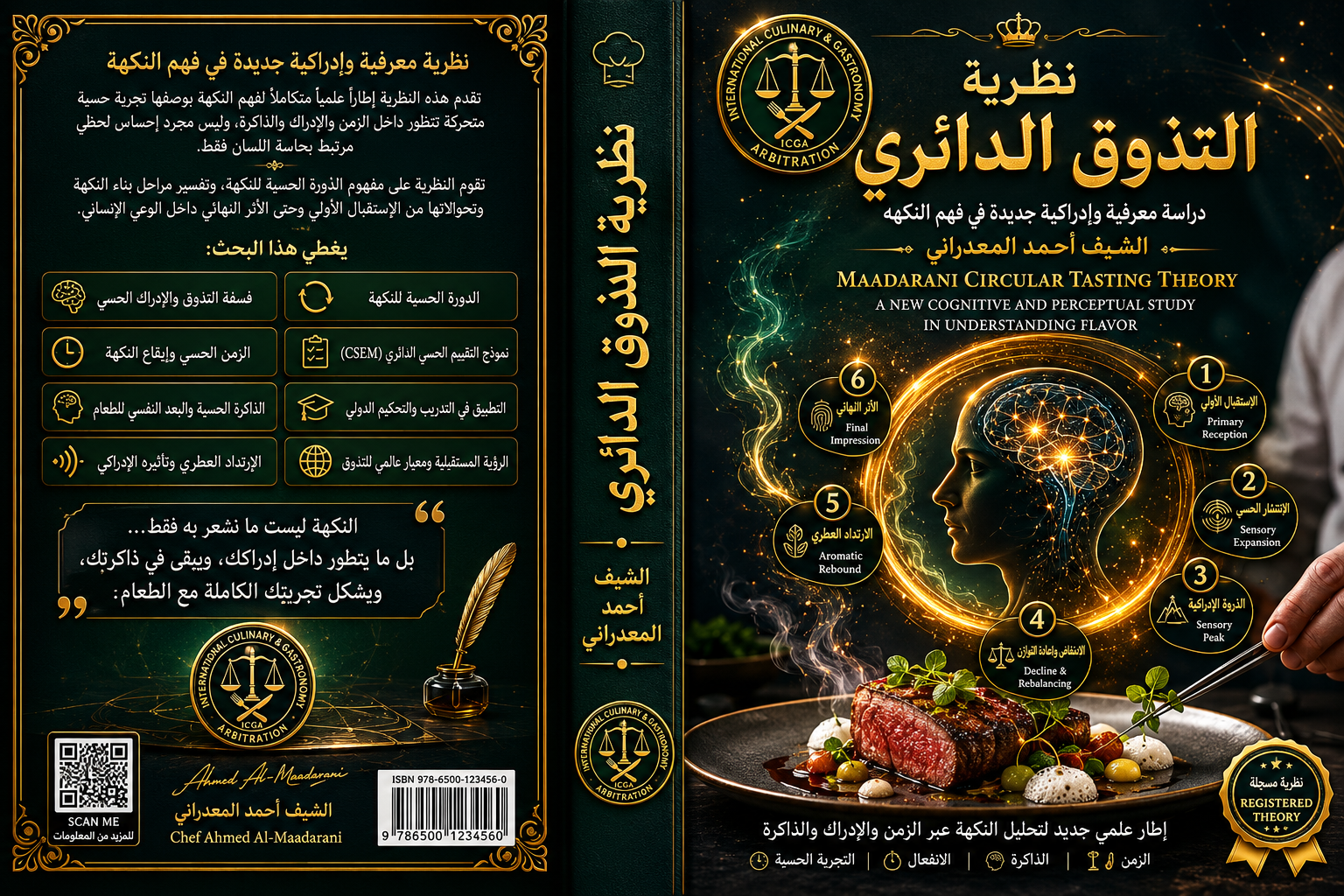
The model relies on six main stages derived from the Circular Flavor Cycle. The first stage is Primary Reception Evaluation. Here, the clarity of the beginning, initial balance, quality of first impression, and early harmony of flavor are analyzed. This evaluation is not considered a final judgment, but a starting point for the rest of the sensory cycle.
The second stage is Sensory Expansion Evaluation. It includes the development of layers, emergence of secondary flavors, internal flow of flavor, and balance during expansion. At this stage, the ability of food to move from simplicity to perceptual depth is measured.
The third stage is Sensory Peak Evaluation. Here, the strength of the peak, sensory integration, aromatic harmony, and psychological effect of the highest perceptual moment are analyzed. It is also evaluated whether the peak is natural and gradual, or sharp and confusing to the senses.
The fourth stage is Decline and Rebalancing Evaluation. It examines the stability of the ending, the quality of transition after the peak, the maintenance of balance, and the appearance of deep layers. This stage is very important for revealing defects that do not appear during the beginning or peak.
The fifth stage is Aromatic Rebound Evaluation. It includes the strength of aromatic return, continuity of aromas, delayed perceptual depth, and quality of the sensory return of flavor. This stage is one of the most important elements distinguishing the model from traditional evaluation systems.
The sixth stage is Final Sensory Impression Evaluation. Here, flavor stability in memory, final psychological emotion, duration of sensory effect, and perceptual identity of food are analyzed. This stage represents the “true final judgment” of the quality of the complete sensory cycle.
Circular Tasting Theory uses the concept of Sensory Continuity Score. This is a measure used to determine the degree of connection among the stages of the cycle and the ability of food to preserve its perceptual identity from beginning to end.
The model can be used in international judging, food product evaluation, training of chefs and tasters, modern dish development, fine dining experience design, and academic sensory research.
The theory holds that CSEM is not merely an evaluation form. It is a new framework for understanding food as a moving temporal experience. The value of the model lies in its ability to analyze the “journey of flavor,” not only the “visible taste.”
Thus, CSEM forms the first practical application of Circular Tasting Theory. It provides a professional foundation for transforming concepts of sensory perception and flavor time into analytical tools usable in modern culinary arts and professional judging.
Applying the CSEM Model in Professional Analysis
For the Circular Sensory Evaluation Model (CSEM) to become an effective practical tool, it must be applied within a clear methodology that allows the food’s sensory cycle to be analyzed accurately and systematically. Circular Tasting Theory therefore offers a set of applied principles that help judges, tasters, and researchers use the model professionally.
Application of the model depends on a central idea: tasting is not one moment, but a sequence of stages that must be observed and analyzed temporally. The taster therefore does not stop at direct judgment, but follows the development of flavor from the beginning until the final effect stabilizes within perception.
The theory uses the concept of Sequential Sensory Tracking. This is a method based on observing the movement of flavor through time and recording the perceptual changes it undergoes during the complete sensory cycle.
The practical application of the model begins by preparing an appropriate sensory environment, because external factors directly influence food perception. Evaluation is preferably conducted under stable conditions in terms of lighting, surrounding aromas, noise, temperature, and the taster’s psychological state. This ensures the greatest possible degree of perceptual accuracy.
The taster then begins with Sensory Entry Observation, during which the first impression, speed of flavor appearance, nature of the beginning, and initial balance are recorded.
The taster then gradually moves to observing the stage of sensory expansion, focusing on the development of layers, appearance of secondary aromas, textural changes, and thermal transition. At this stage, final judgment should be avoided because flavor has not yet revealed its complete personality.