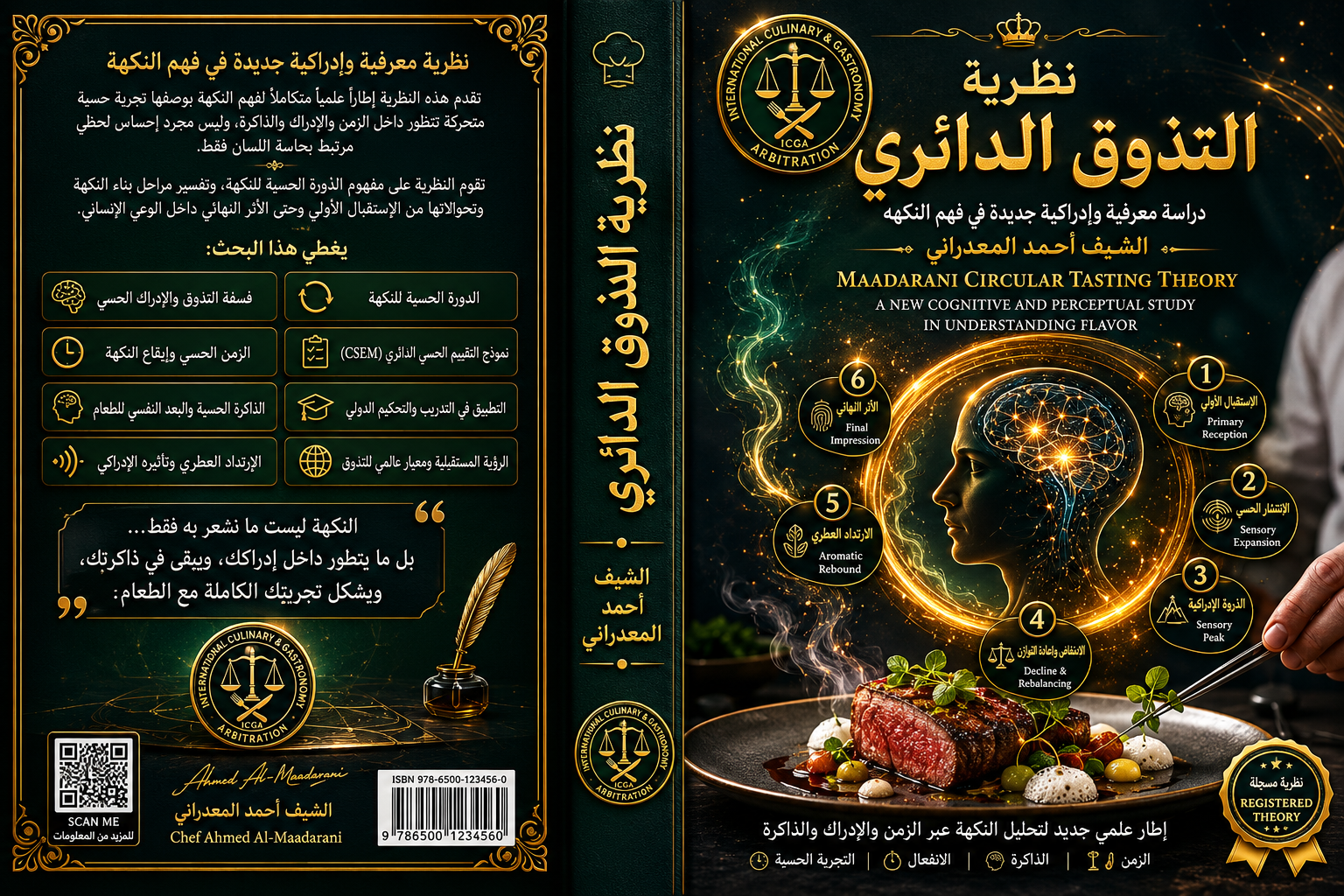
المعدراني، أحمد. (2026). نظرية التذوق الدائري: دراسة معرفية وإدراكية جديدة في فهم النكهة. IUOAMC Global Platform.
The theory can also be used to develop specialized curricula for chefs and judges by dividing the sensory cycle into independent educational stages. The trainee learns how flavor begins, how it spreads, how it reaches the peak, how it declines, how it returns aromatically, and how it settles in memory. This creates a more precise understanding of food than direct traditional tasting.
In professional kitchens, this type of education helps chefs develop the ability to “design flavor” rather than merely produce it. When a chef understands how perception moves through time, he or she becomes capable of building dishes with greater depth, influence, and stability.
The theory also holds that modern sensory education must include the psychological and emotional side of tasting, because food is perceived not only through the senses, but also through feeling, memory, and attention. Understanding the relationship between flavor and emotion therefore becomes an essential part of forming the professional taster.
In this context, training laboratories can be created that rely on the analysis of sensory time, observation of aromatic rebound, comparison of flavor-cycle speeds, study of thermal transformations, and testing of sensory persistence. This transforms culinary education into an integrated perceptual science.
Circular Tasting Theory also affirms that the future of sensory education will move toward building “perceptual analysts of food,” not only traditional tasters. The true professional is one who can understand flavor structure, rhythm, transformations, psychological effect, and relationship to memory and time, not merely describe visible taste.
The theory therefore offers a new foundation for professional sensory education. Tasting changes from a simple descriptive skill into an advanced perceptual science aimed at understanding the complete movement of flavor within the senses, mind, and human memory.
The Future of Circular Tasting in Modern Culinary Science
Circular Tasting Theory represents an attempt to rebuild the human understanding of flavor from a comprehensive temporal and perceptual perspective. It is therefore not merely an explanatory theory of tasting, but an intellectual project that can influence the future of culinary science, sensory analysis, food education, and the perceptual design of food.
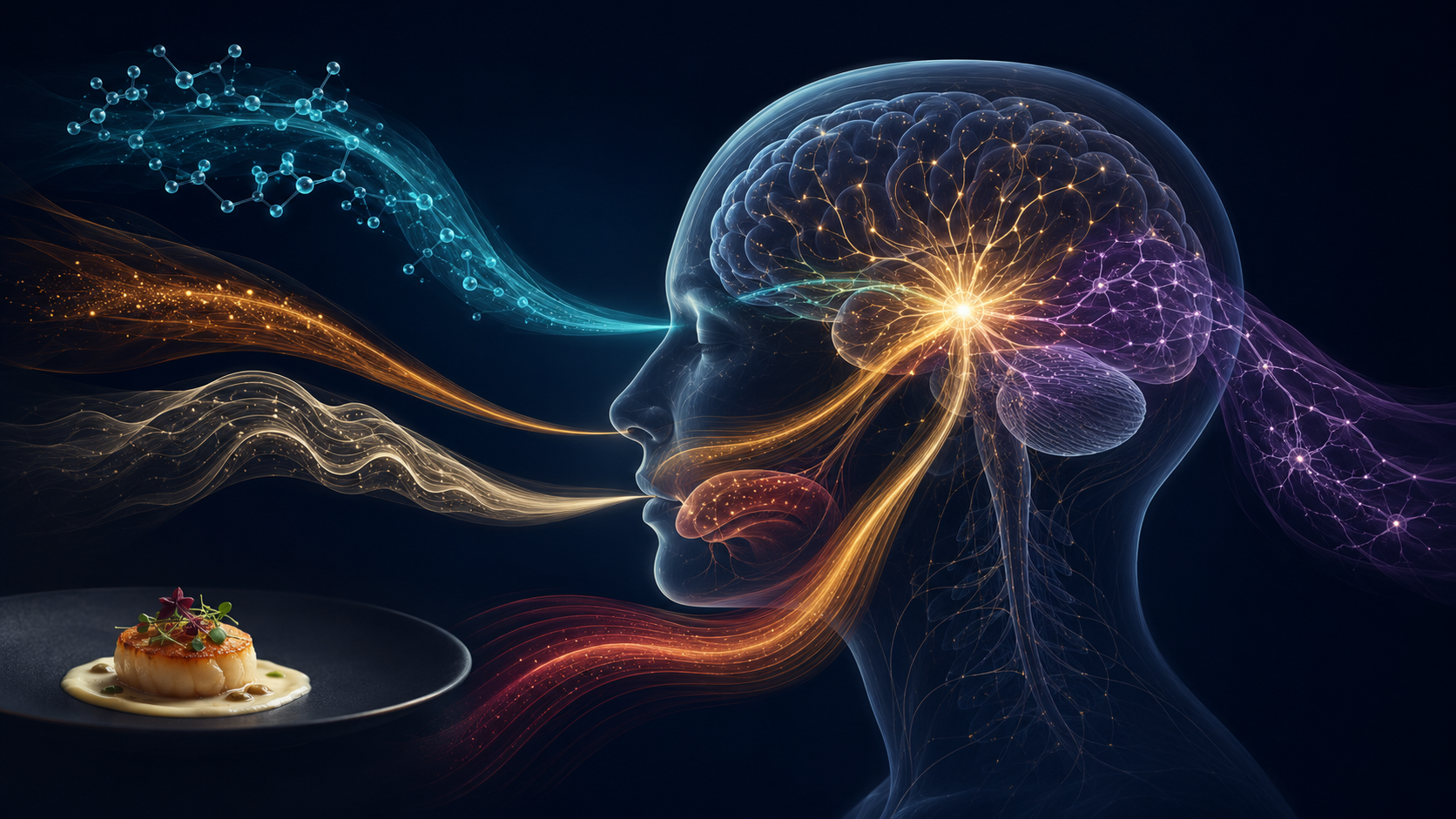
In previous decades, scientific focus in the culinary world was directed toward food chemistry, cooking techniques, food safety, ingredient analysis, and taste balance. Today, with the development of neuroscience, sensory studies, and experiential science, attention is beginning to move toward understanding “how food is perceived,” not only “what food is made of.” This is where Circular Tasting Theory becomes significant as a framework that connects time, perception, memory, psychological emotion, and the sensory movement of flavor.
The theory holds that the future of culinary arts will not depend only on producing stronger or more complex flavors. It will depend on designing sensory experiences that are more conscious and better organized. The future chef may therefore become a Culinary Sensory Designer, working to build the rhythm of flavor, the path of transformations, the timing of the peak, the nature of the final effect, and the psychological connection of food, rather than focusing only on the traditional recipe.
The theory may also influence the future of international judging, culinary education, restaurant design, food product development, professional tasting experiences, food quality analysis, and sensory research by adopting the concept of the “complete sensory cycle” instead of relying on direct momentary impressions.
The theory uses the concept of Future Sensory Gastronomy. This is a direction based on understanding food as a multilayered experience moving through time, the senses, and awareness, rather than as a consumable substance linked only to satiety or visible taste.
Circular Tasting Theory also holds that future technical development—such as artificial intelligence, sensory data analysis, and neural simulation technologies—may allow the creation of more precise systems for analyzing flavor speed, stability, aromatic rebound, perceptual balance, and the psychological effect of food. This may transform tasting into an analytical science that can be measured with greater precision than ever before.
In the academic field, the theory can become a foundation for developing new curricula, perceptual analysis laboratories, sensory evaluation systems, professional courses, and specialized research into the sensory time of flavor. It can also serve as a basis for building modern standards for evaluating refined and complex foods.
From a philosophical perspective, Circular Tasting Theory redefines the relationship between human beings and food. Eating is not seen as merely a biological act, but as a moving human experience in which the senses, mind, time, memory, emotion, and cultural identity interact. Food therefore becomes a means of understanding human perception as much as it is a means of nutrition.
The theory also affirms that true flavor is not something that is consumed and then ends. It is an experience that extends within awareness and continues to influence the human being after eating has ended. Circular tasting may therefore represent the beginning of a new stage in modern culinary science, one in which flavor moves from the concept of “taste” to the concept of the “complete perceptual experience.”
Thus, Circular Tasting Theory offers a future vision in which the understanding of food will not be based only on ingredients and techniques, but on studying how flavor moves within time, awareness, and human memory. This may open the door to an entirely new school in global culinary science and sensory analysis.
Circular Sensory Evaluation Model (CSEM)