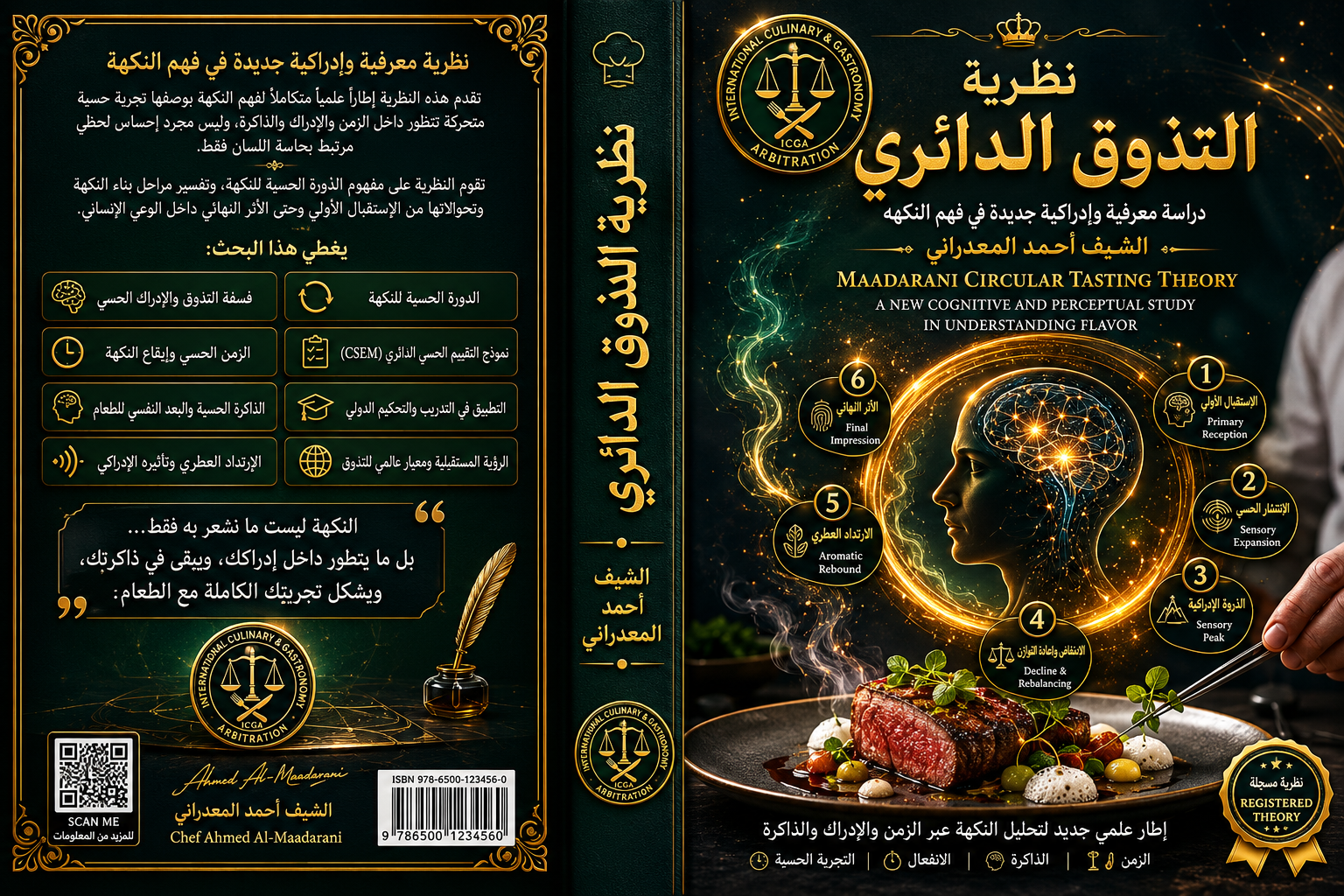
المعدراني، أحمد. (2026). نظرية التذوق الدائري: دراسة معرفية وإدراكية جديدة في فهم النكهة. IUOAMC Global Platform.
In professional sensory analysis, the theory helps explain why some sauces or fermented products seem “alive and developing,” while others seem flat despite strong flavor. The key is not intensity alone, but the ability of flavor to continue, transform, and interact within the sensory cycle.
Thus, Circular Tasting Theory affirms that fermented foods and complex sauces represent one of the highest forms of temporal flavor, where the food experience becomes a changing perceptual system that reveals itself gradually through the continuous movement among senses, time, and memory.
Circular Tasting and the Design of Modern Sensory Experiences
The design of sensory experiences has become one of the main directions in modern culinary arts. The aim of a dish is no longer merely to satisfy hunger or provide a delicious flavor, but to create an integrated perceptual experience that affects the senses, memory, and psychological emotion in a deliberate way. Circular Tasting Theory offers an advanced framework for understanding how such experiences can be built and organized through time.
In the past, chefs focused mainly on ingredient quality and cooking techniques. Today, many chefs work on “sensory perception engineering,” meaning the design of the way flavor will move inside the taster’s awareness step by step. This transformation makes food closer to an artistic experience or an integrated sensory scenario.
The theory uses the concept of Sensory Experience Architecture. This refers to the deliberate construction of the food’s sensory cycle, in which the perceptual beginning, speed of expansion, timing of the peak, nature of decline, moment of aromatic rebound, and form of final effect are all controlled. Each of these elements is designed to create a specific emotional and sensory response within the taster.
Circular Tasting Theory also holds that the modern food experience no longer depends only on taste. It depends on full interaction among sight, sound, temperature, texture, aromas, time, lighting, presentation, and movement. Some fine restaurants therefore build their dishes within a “perceptual narrative” that begins from the moment the dish is seen and continues until the final sensory trace.
One important characteristic of modern sensory experiences is their reliance on “organized surprise.” Some dishes are designed to hide certain flavor layers and then reveal them later during tasting, creating a sense of discovery and continuous interaction with the food.
Modern techniques—such as controlled fermentation, aromatic smoking, thermal contrast, and textural layering—are also used to control the movement of the sensory cycle more precisely. The chef thus becomes capable of “programming” the development of flavor within the taster’s perceptual time.
The theory also indicates that the modern sensory experience does not aim only to impress, but to create a “long-term perceptual effect.” A successful dish is not one that attracts attention for a moment, but one that remains present within memory because of the quality and balance of its sensory journey.
In this context, the concept of Emotional Sensory Design appears. This refers to the use of flavor, sensory rhythm, aromatic details, and textures to evoke specific emotions such as comfort, nostalgia, wonder, calm, excitement, or contemplation. Food thus becomes a medium for psychological and emotional influence, not merely a direct taste experience.
Circular Tasting Theory holds that the future of culinary arts will increasingly move toward building “multilayered experiences” based on a deeper understanding of human perception and sensory time. The future chef will therefore be not only an expert in cooking, but also an analyst of perception, a designer of sensory memory, an engineer of flavor time, and a guide of sensory emotion.
In professional training, the theory can be used to teach chefs how to design dishes that pass through deliberate perceptual stages, rather than relying only on the momentary power of taste.
Thus, Circular Tasting Theory affirms that designing modern sensory experiences is a natural development in understanding food as an integrated perceptual experience. Flavor becomes a temporal, emotional, and philosophical journey constructed carefully within the senses, awareness, and human memory.
Circular Tasting and Professional Sensory Education
With the development of modern culinary arts and the increasing complexity of food experiences, it has become necessary to reconsider methods of training chefs, tasters, and judges. Traditional education often focuses on identifying basic flavors and mastering cooking techniques, while Circular Tasting Theory affirms that professional tasting requires deeper training that includes understanding sensory time, perceptual transformations, aromatic layers, and flavor dynamics within the complete food cycle.
The theory holds that many tasters possess a natural ability to sense taste, but lack the “analytical awareness” needed to understand the movement and development of flavor. Modern sensory education must therefore move from training the tongue alone to training the full perception of the senses, memory, and temporal attention.
The theory uses the concept of Sensory Cognitive Training. This refers to training programs aimed at developing the trainee’s ability to follow the stages of the sensory cycle, analyze temporal transformations, understand flavor rhythm, notice delayed layers, analyze aromatic rebound, and measure the final effect of food.
In this model, tasting becomes an analytical skill that can be developed through training and practice, not merely an innate talent. Circular Tasting Theory also affirms that professional sensory education should include training in Slow Sensory Observation. This method relies on calm and gradual tasting rather than rapid evaluation, allowing the trainee to notice how flavor moves through time and perception.