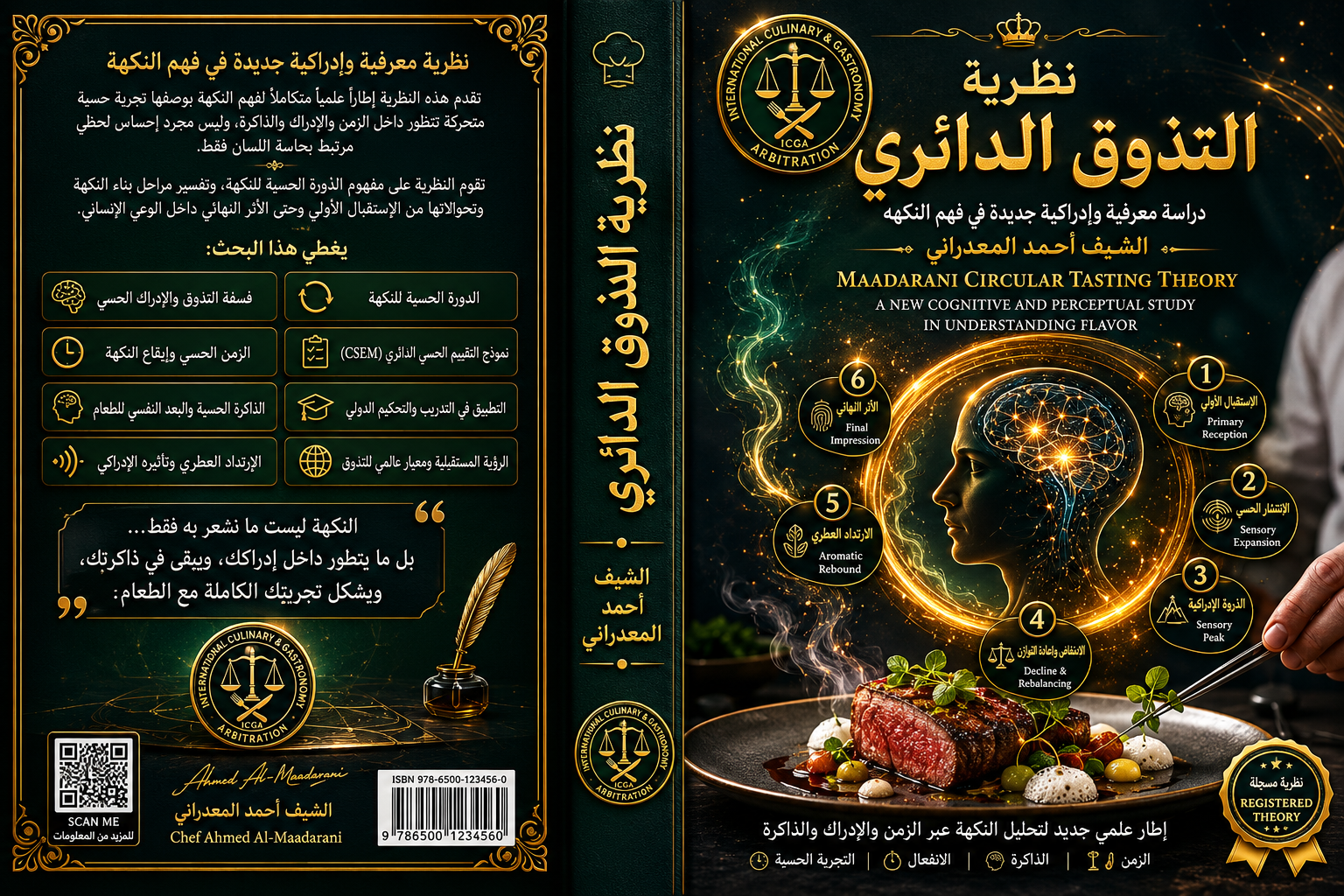
المعدراني، أحمد. (2026). نظرية التذوق الدائري: دراسة معرفية وإدراكية جديدة في فهم النكهة. IUOAMC Global Platform.
Circular Tasting Theory uses the concept of Progressive Flavor Revelation. This refers to the way coffee or chocolate reveals its sensory layers sequentially rather than all at once. Fast or unconscious tasting may therefore prevent the taster from reaching the true depth of the experience.
Specialty coffee clearly reveals the concept of “thermal flavor transition.” As coffee temperature decreases, new notes appear that were not clear at higher heat. This confirms that flavor is not fixed, but moves within time and temperature through a changing perceptual cycle.
Fine chocolate, especially dark chocolate, provides another model of an extended sensory cycle. It often begins with light bitterness or fatty intensity, then gradually opens toward softer and more complex flavors such as dried fruits, caramel, spices, or woody aromatic notes.
The slow melting process inside the mouth also plays an important role in building chocolate’s sensory cycle, as aromatic and taste compounds are released gradually, allowing multiple and changing layers to appear within perception.
The theory uses the concept of Controlled Sensory Dissolution. This refers to the way gradual dissolution of food organizes the appearance of flavor through time. This concept is essential for understanding products that depend on fats, cocoa butter, and aromatic oils.
Coffee and chocolate also clearly demonstrate the importance of aromatic rebound, final effect, sensory memory, temporal balance, and perceptual rhythm. These elements are central to Circular Tasting Theory.
In professional specialty coffee analysis, tasters already rely—whether directly or indirectly—on some principles of the circular cycle. They observe acidic beginning, body development, aromatic transformations, finish, and sensory continuity. The theory, however, adds a deeper philosophical and scientific dimension by connecting these stages within a unified perceptual framework.
Circular Tasting Theory holds that refined coffee and chocolate products do not aim only at momentary impact. They aim to create a “long-lasting sensory presence.” True quality is therefore not measured only by the strength of flavor, but by its ability to develop and remain in awareness after tasting has ended.
In modern professional kitchens and specialty shops, this theory can be used to develop tasting methods, judging systems, taster training, sensory experience design, and product flavor identities. It is therefore a practical tool as well as an intellectual and analytical framework.
Thus, Circular Tasting Theory affirms that specialty coffee and fine chocolate are not merely food products. They are moving perceptual experiences that clearly show how flavor can develop, transform, and return within time, the senses, and memory in an integrated circular way.
Circular Tasting in Fermented Foods and Complex Sauces
Fermented foods and complex sauces are among the food environments that most clearly demonstrate the principles of Circular Tasting Theory. By nature, they depend on temporal transformation, sensory accumulation, and gradual balance among different layers of flavor. In these products, flavor is neither direct nor simple. It is formed through a long path of chemical and perceptual development.
In fast or direct foods, flavor often appears clearly and specifically from the beginning. Fermented products, however, have the ability to “change continuously” inside the mouth and sensory awareness. Fermentation produces aromatic compounds, acids, and enzymes that make flavor multilayered and temporally extended, giving it a long sensory cycle rich in transformations.
The theory uses the concept of Deep Flavor Evolution. This refers to the gradual maturation of flavor within perception, where the true layers of food are understood only after several stages of the sensory cycle have passed. This concept appears clearly in aged sauces, miso, fermented soy products, aged cheeses, kimchi, natural vinegar, and smoked or fermented products.
In such foods, the beginning becomes only a “first signal,” while the true depth reveals itself during the peak, decline, and aromatic rebound.
Complex sauces also have the ability to create a “multidirectional flavor sequence.” A sauce may begin with slight sweetness, then move toward acidity, after which smoky depth, fermentation, heat, or umami may appear in later stages. This continuous change makes the sensory cycle more dynamic and richer.
The theory holds that a professional sauce is not built only to achieve chemical balance, but to achieve temporal balance, perceptual fluidity, control of sensory rhythm, continuity of effect, and aromatic return. The success of a sauce therefore depends not only on its ingredients, but on how those ingredients move within the circular flavor cycle.
Fermented foods also have exceptional ability to produce Extended Aromatic Persistence. Aromas and sensory effects remain for a long time within perception after eating ends because of the richness of volatile compounds created by fermentation and temporal maturation.
Another important characteristic is that these foods require a “patient taster” capable of following transformations without judging too quickly. Some fermented flavors may seem sharp or strange at the beginning, but later transform into deeper and more balanced sensations after time has passed.
In modern fine kitchens, fermentation and complex sauces have become tools for building long-lasting sensory experiences. The aim is not merely to enhance taste, but to create a continuous “movement of flavor” within perception.
Circular Tasting Theory holds that these products reveal the deep relationship among time, transformation, maturation, memory, and sensory perception. They represent foods that cannot be understood through the moment alone, but through the complete journey flavor undergoes within mind and senses.