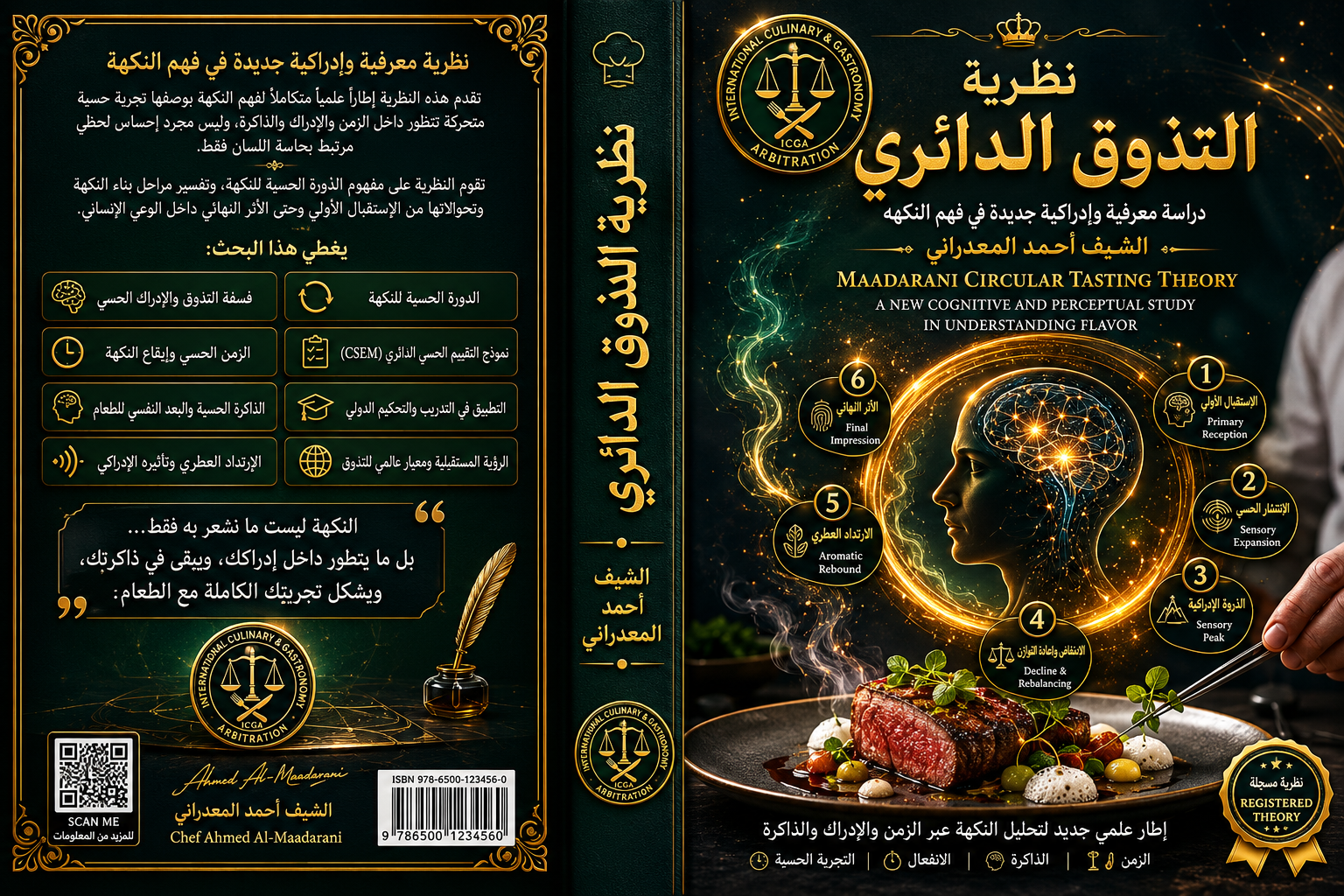
المعدراني، أحمد. (2026). نظرية التذوق الدائري: دراسة معرفية وإدراكية جديدة في فهم النكهة. IUOAMC Global Platform.
When flavor reaches the end of all its stages—from initial reception to final aftereffect—the circular cycle has been fully completed within the taster’s sensory perception. At this moment, food is no longer merely a sequence of separate sensory signals. It becomes an integrated “flavor identity” stabilized within awareness, memory, and psychological emotion.
Circular Tasting Theory considers that the completion of the cycle does not mean only the end of tasting. It means that flavor has reached the stage of full perceptual maturity. Each stage of the cycle adds a new element to the experience, and as these elements accumulate, the final image of food is formed inside the brain.
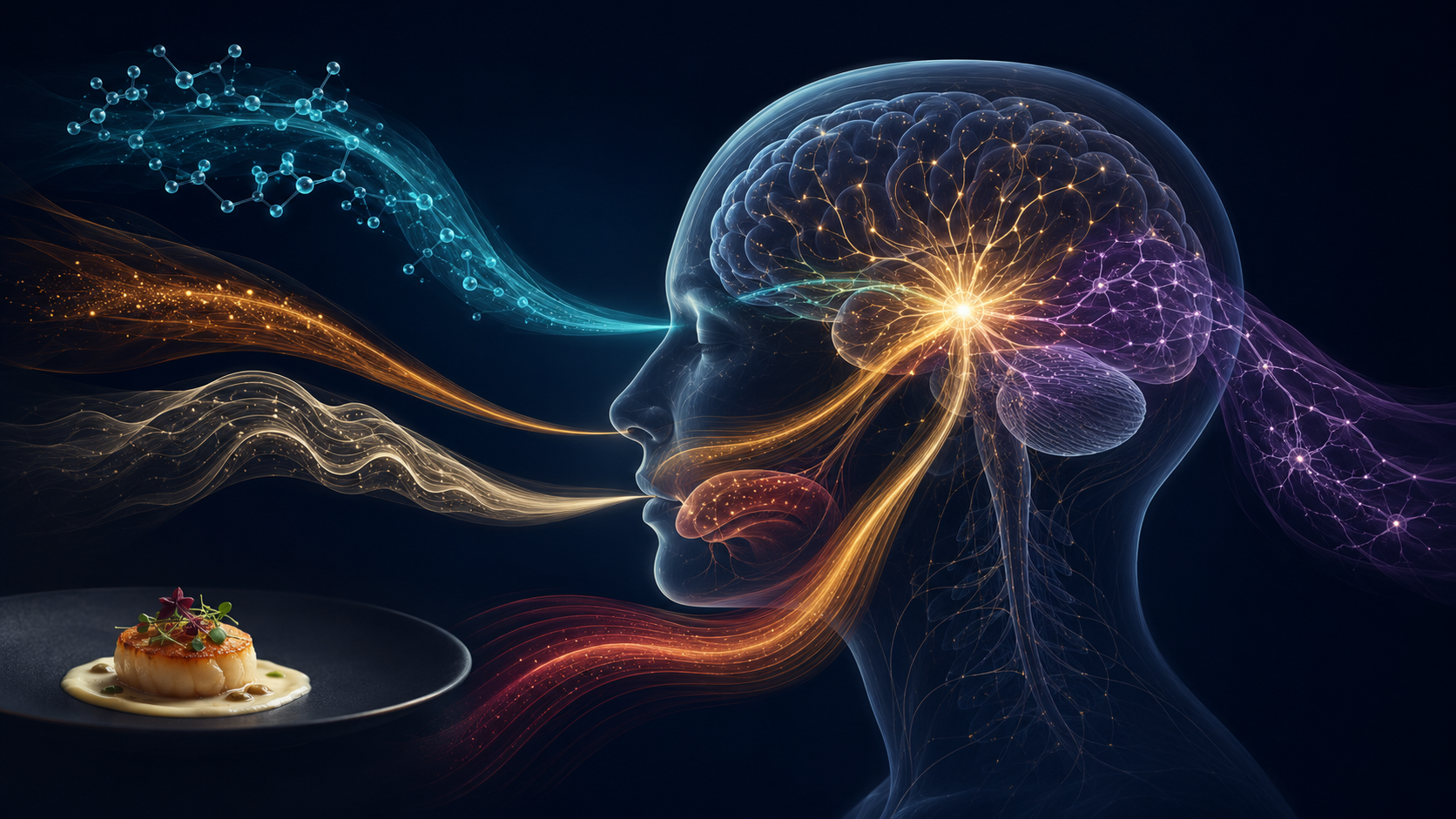
The theory uses the concept of Final Flavor Identity. This refers to the overall impression that remains inside the taster after all sensory and temporal transformations have ended. This identity is not formed from taste alone. It is formed from the totality of the beginning, expansion, peak, balance, decline, aromatic return, psychological effect, and temporal memory. Real food is therefore not measured by one moment, but by the complete path flavor has followed within perception.
The theory also affirms that completion of the cycle gives food an “independent personality.” Some dishes have a clear presence that can be easily recognized because of the strength of their sensory identity. Other dishes lack this coherence and seem fragmented or without long-term effect despite their technical quality.
One important characteristic of final identity is that it depends more on the “connection among stages” than on the strength of any single stage. The beginning may be moderate but the ending exceptional, or the peak may be strong but the final effect weak. This changes the overall judgment of the food experience.
Circular Tasting Theory holds that a successful professional food creates sensory continuity, temporal harmony, balanced transformation, stable aromatic memory, and deep psychological effect. When these elements are achieved, the “complete flavor cycle” is formed, and the food experience becomes coherent rather than a series of random sensations.
The theory also indicates that completion of the cycle allows the taster to form a “stable mental image” of the food. After the experience ends, the brain can recall the flavor in an almost complete way, not only through taste, but through the temporal, emotional, and thermal sensations associated with it.
In this context, flavor becomes an “organized sensory memory” that can be recalled later even in the absence of the food itself. Some dishes remain present in the human mind for years because they succeeded in building a complete and coherent sensory cycle within perception.
Completion of the cycle also represents a transition point toward the professional use of the theory. Understanding how the final identity of food is formed allows for the development of more precise systems in culinary judging, dish development, quality analysis, sensory training, and modern food-experience design. From here, Circular Tasting Theory moves from being a philosophical explanation of tasting to becoming a practical framework applicable in professional and academic contexts.
Thus, the theory affirms that true flavor is not merely a taste that appears and then disappears. It is an integrated sensory journey that ends by forming a stable “perceptual identity” within awareness, making food an extended human experience that goes beyond the physical moment of tasting.
Circular Tasting in Professional Culinary Judging
Professional culinary judging is one of the most important applied fields that can benefit from Circular Tasting Theory. Most traditional evaluation systems depend heavily on the first impression or on the momentary evaluation of food, while this theory affirms that true flavor cannot be understood except by following the complete sensory cycle and analyzing its temporal and perceptual development.
In many cooking competitions, judgments are issued within short moments. This pushes some judges to focus on the strength of the beginning, the beauty of presentation, or the immediate effect of the dish. Yet this method may neglect deep or complex foods that need time to reveal their true personality within sensory perception.
Circular Tasting Theory therefore proposes redefining the professional evaluation of food so that judgment does not depend only on “the moment of tasting,” but on the complete “journey of flavor,” including the sensory beginning, expansion, peak, balance, temporal transformations, aromatic return, and final effect.
The theory uses the concept of Circular Judging Perception. This refers to the judge’s ability to analyze food by following the full sensory cycle rather than being limited to immediate response. In this model, the judge becomes an observer of the internal movement of flavor, not merely a receiver of direct taste.
The theory also holds that the professional judge must possess specific skills, including temporal awareness of flavor, recognition of delayed layers, analysis of sensory rhythm, understanding of dynamic balance, evaluation of aromatic rebound, and measurement of the continuity of perceptual effect. These skills go beyond traditional evaluation, which often focuses mainly on visible taste.
Some highly professional foods may not seem impressive at the beginning, but reveal their true complexity during later stages of the sensory cycle. Rapid judgment may therefore be unfair to dishes that possess real perceptual depth.
Circular Tasting Theory also helps identify hidden defects that may not appear in the first moment, such as collapse of balance after the peak, weak final effect, rapid disappearance of flavor, disorder in temporal transformations, and absence of stable sensory identity. Judging therefore becomes more precise, fair, and comprehensive.