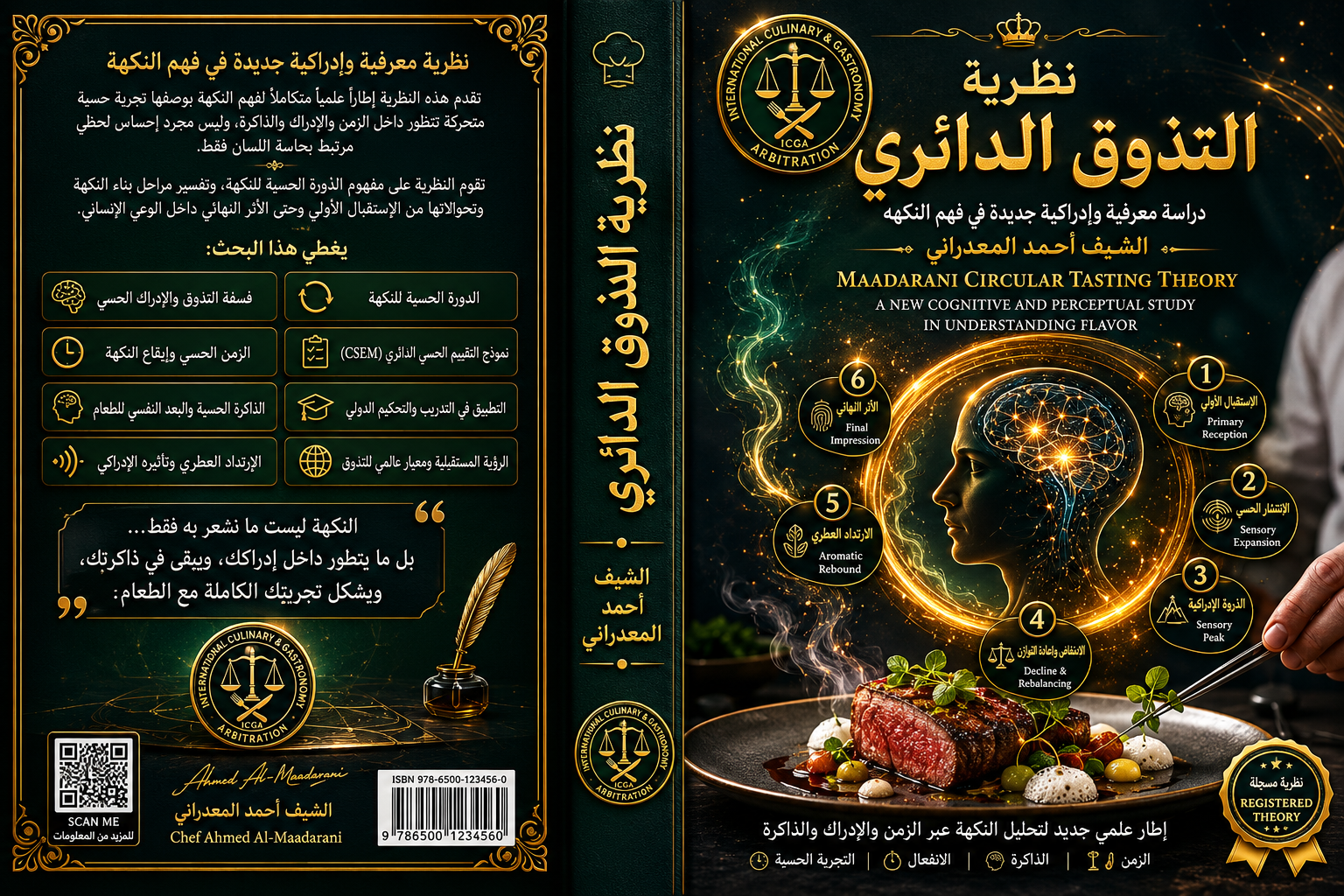
المعدراني، أحمد. (2026). نظرية التذوق الدائري: دراسة معرفية وإدراكية جديدة في فهم النكهة. IUOAMC Global Platform.
The idea of this research arises from the observation that many judgments about food are based only on first impressions, even though the true sensory experience of food develops over time and includes subtle transformations in taste, aroma, texture, and psychological effect. Some refined or complex foods do not reveal their complete structure until several successive perceptual stages have passed. This makes rapid judgment insufficient for understanding their true sensory value.
The research focuses on achieving several core objectives. The most important are: building a theoretical framework that explains the mechanism through which flavor develops within human perception; analyzing the relationship between tasting and time; and understanding the role of sensory memory in shaping the final impression of food. It also seeks to develop a new professional concept that can be used in advanced culinary judging, modern dish design, and the training of chefs and tasters to analyze flavor with greater depth and precision.
Another central objective is to propose a practical model for evaluating flavor based on the complete sensory cycle, rather than relying only on momentary tasting. This model is expected to improve the quality of professional evaluations and to develop fairer and more precise methods for analyzing complex foods in international competitions and fine kitchens.
The main research problem is expressed in the following question: Is tasting a momentary linear process, or is it a changing circular perceptual experience that moves within an integrated sensory cycle?
Several sub-questions emerge from this main question: Why does flavor change during chewing and after swallowing? How does sensory memory influence the reinterpretation of taste? Can flavor return perceptually after its apparent disappearance? What is the role of time in building the quality of the food experience? Can a judging system be developed that relies on the stages of flavor development rather than on first impression? Do some foods possess a longer and more complex “flavor cycle” than others?
By addressing these questions, the study seeks to establish a new scientific conception that treats flavor as a moving temporal experience and grants tasting a deeper perceptual dimension that goes beyond traditional concepts associated with the tongue alone.
Hypotheses and Conceptual Framework
Circular Tasting Theory begins from a central hypothesis: tasting is not a momentary sensory event, but a temporal perceptual process that passes through successive stages in which flavor reshapes its presence within human sensory awareness. According to this view, taste is not perceived only once. Rather, it moves through a changing cycle influenced by time, breathing, memory, neural response, and psychological emotion.
The theory assumes that many traditional evaluation systems in the culinary arts rely excessively on first impression, while the true value of some foods is formed during later stages of the sensory experience. Therefore, professional judgment of food should depend on the “complete path of flavor,” not only on the first moment of contact.
The theory is built on several interconnected hypotheses that form the basic intellectual structure of this research. The first hypothesis states that flavor moves within a changing sensory cycle that begins with initial reception and then develops gradually through multiple stages. The second hypothesis affirms that time is an internal element in the structure of flavor, not merely an external framework for tasting. The quality of perception changes as the duration of sensory interaction with food changes.
The theory also assumes that sensory memory participates directly in reconstructing flavor within the brain. Tasting therefore does not depend only on sensory receptors, but also on continuous comparison between the current experience and previous experiences stored in the taster’s perceptual awareness. Food may thus evoke emotional or perceptual responses that differ from one person to another according to each individual’s sensory background and taste memory.
The theory further points to the existence of what may be called the “perceptual return of flavor.” This is the stage in which certain aromatic or taste-related effects return after the direct sensation of food has disappeared, especially through retronasal breathing or aromatic rebound within the olfactory system. This stage is one of the key foundations that distinguishes circular tasting from traditional linear models.
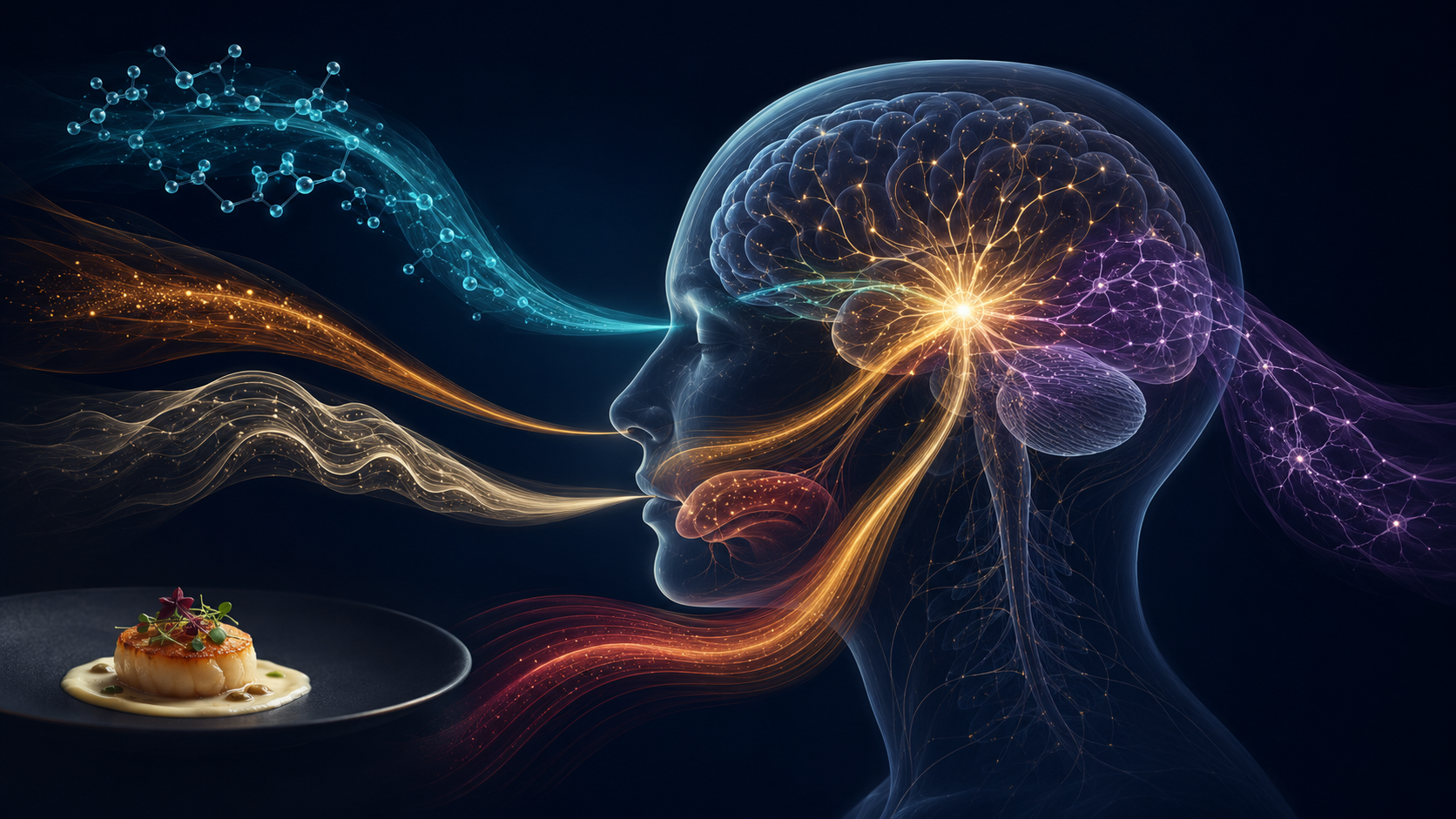
Within its conceptual framework, the theory considers tasting a multidimensional process in which several basic elements interact: taste, aroma, time, memory, neural perception, psychological emotion, thermal structure, and food texture. The ongoing interaction among these elements creates the “sensory cycle of flavor,” the path through which the food experience moves within human perception.
Accordingly, this study proposes a shift from the concept of “fixed tasting” to the concept of “moving tasting,” where flavor becomes a dynamic, changing experience that can be analyzed, measured, and studied within an integrated temporal model. This may form the basis of a new school in sensory analysis and the modern culinary arts.
Theoretical Foundation of Circular Tasting
The concept of Circular Tasting is based on reinterpreting the tasting experience as a continuous perceptual movement rather than as a separate sensory response. Traditional models in food analysis often view tasting as a direct interaction between the food substance and the receptors of the tongue. This theory, however, proposes that flavor goes beyond the boundaries of the initial chemical interaction and enters a more complex system that includes time, awareness, memory, and neural response.