المعدراني، أحمد. (2026). نظرية التذوق الدائري: دراسة معرفية وإدراكية جديدة في فهم النكهة. IUOAMC Global Platform.
The theory also affirms that this overlap is an important indicator of food quality. Refined dishes do not move between stages in a sudden or fragmented way. They allow flavor to transform gradually between different states without collapse or sensory shock. Weak foods, by contrast, often show a sharp separation between beginning, peak, and ending, making the experience perceptually unstable.
The brain itself contributes to this overlap. Human perception does not separate sensory signals with strict precision; it integrates them into one flowing experience. Aromatic memory may continue to influence the peak, or the psychological effect of the beginning may remain present until the end.
The speed of tasting also affects the degree of overlap among stages. Slow tasting allows gradual transitions to appear more clearly, while fast tasting compresses the stages into a sensory experience that may lose subtle details.
Circular Tasting Theory considers this overlap not as a defect, but as part of the true nature of food perception. Flavor is not a set of separate signals. It is a composite sensory state in which aromas, tastes, heat, texture, emotion, and memory move within an interconnected perceptual network.
Overlap appears strongly in multilayered foods such as fermented dishes, complex sauces, specialty coffee, professional chocolate, and composed desserts. In these foods, several sensory waves interact at the same time, giving the experience greater depth and complexity.
In professional sensory analysis, understanding this overlap helps explain why some foods seem “alive” and developing, while others seem flat or mechanical. The more fluid and connected the transitions between stages are, the higher the quality and coherence of the sensory cycle.
Thus, Circular Tasting Theory affirms that flavor is not merely a series of separate stages. It is an interwoven sensory system moving dynamically through time and perception, where all stages interact to form a unified and multidimensional food experience.
Sensory Cycle Speed and Variations in Perceptual Rhythm
Circular Tasting Theory affirms that not all foods move within perception at the same speed. Every flavor has its own “sensory speed,” which determines how it develops and moves between the different stages of the cycle. From this emerges the concept of the “perceptual rhythm of food,” which expresses the time flavor needs in order to be fully understood within the taster’s sensory awareness.
In some foods, the sensory cycle is very fast. Flavor appears strongly and then disappears within a short period without much development. In other foods, flavor moves slowly and reveals its layers gradually, giving the experience greater depth and continuity. This difference is related not only to the type of food, but also to its chemical, thermal, textural, and aromatic structure.
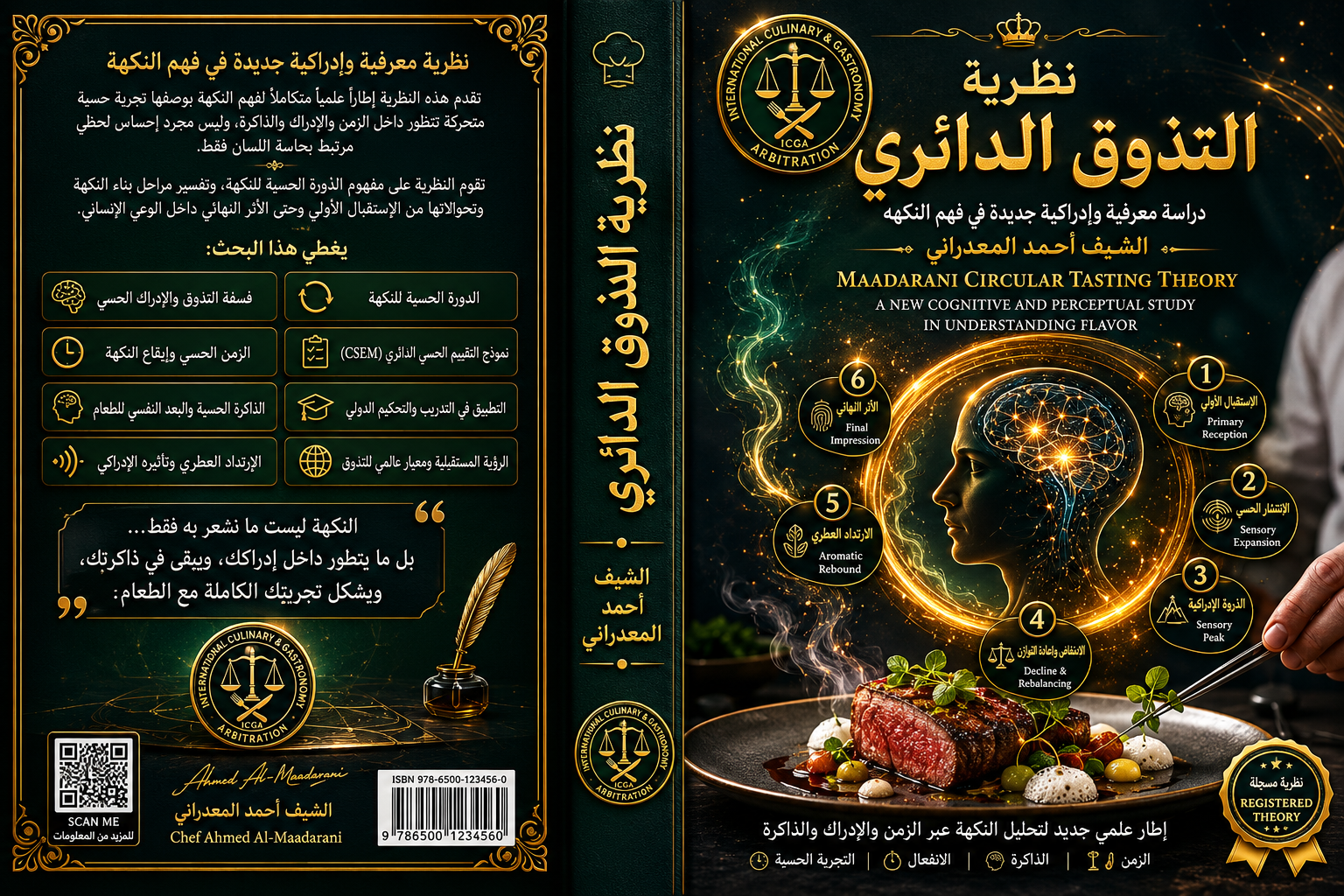
The theory uses the concept of Sensory Cycle Velocity. This refers to the speed at which flavor moves through the stages of primary reception, expansion, peak, decline, aromatic rebound, and final effect. The more balanced and harmonious the movement is, the greater the taster’s ability to understand sensory transformations at a deeper level.
The theory also holds that sensory speed directly affects the psychological emotion of food. Fast foods often generate feelings of surprise, sharpness, or excitement, while slow foods provide feelings of contemplation, depth, and perceptual calm. The temporal rhythm of flavor therefore becomes part of the “emotional personality” of the dish.
Some modern cuisines deliberately manipulate the speed of the sensory cycle. A dish may begin at high speed through a strong taste or sudden heat, then gradually shift into a calmer and more complex experience. Conversely, some dishes are built very slowly until they reach a delayed and deep peak.
Fat, fermentation, and texture also play important roles in determining the speed of the cycle. Foods rich in fat or fermented compounds often have a slower and more extended cycle because aromatic compounds are released gradually inside the mouth and olfactory system. Light or acidic foods tend toward speed, sharpness, and rapid decline.
Circular Tasting Theory also indicates that the taster has a personal “perceptual rhythm.” Some individuals prefer fast and clear flavors, while others are drawn to slow and complex foods that require time, analysis, and contemplation. The relationship between food and taster is therefore not fixed. It depends on the compatibility between the speed of the sensory cycle and the speed of personal perception.
In professional sensory analysis, understanding cycle speed helps evaluate flavor stability, the quality of transformations, the food’s ability to maintain sensory attention, the balance of transitions between stages, and the strength of the final effect. Foods that are temporally unbalanced may appear either too fast and flat or too slow and scattered, while refined foods achieve precise harmony between sensory movement and perceptual time.
The theory also affirms that refined flavor does not reveal everything quickly. It gives perception the opportunity to discover layers gradually. Carefully designed sensory slowness may therefore be a sign of depth, not weakness, just as certain works of art or music require time to be understood fully.
The “perceptual rhythm” thus becomes a fundamental element in understanding the sensory cycle of food. Flavor becomes a temporal experience moving at different speeds within perception, giving each dish its own identity and unique way of influencing the senses, memory, and emotion.
Completion of the Circular Cycle and the Formation of Final Flavor Identity