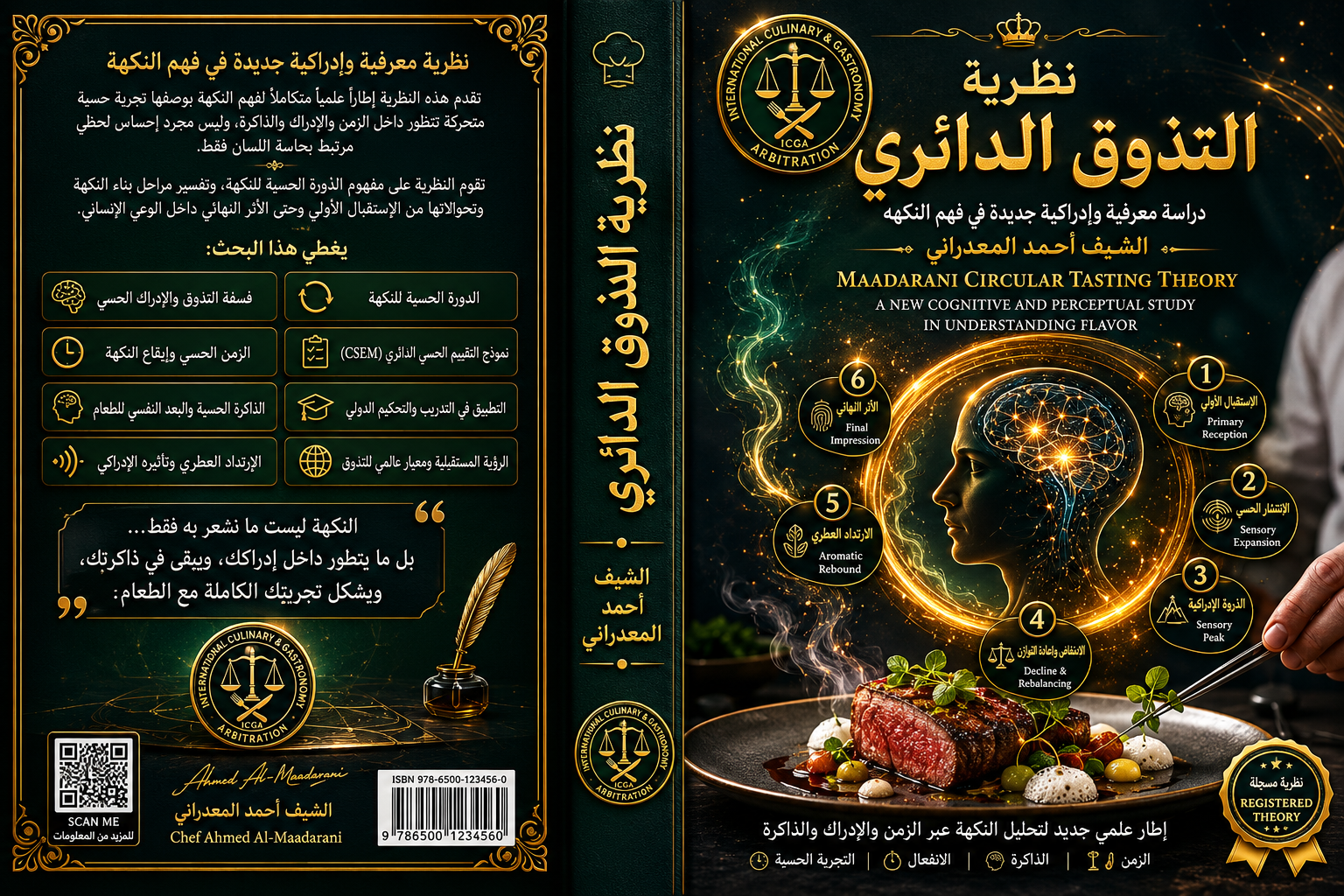
المعدراني، أحمد. (2026). نظرية التذوق الدائري: دراسة معرفية وإدراكية جديدة في فهم النكهة. IUOAMC Global Platform.
One important characteristic of this stage is that it allows “hidden flavors” to appear. Some ingredients cannot be perceived at the beginning because of the dominance of the initial taste. They begin to appear gradually when strong signals calm down and the sensory space of food expands.
Texture plays a fundamental role in organizing the speed of expansion. Creamy or fatty foods allow slower and deeper expansion, while light or dry structures produce fast and short-lived expansion. The physical structure of food therefore directly participates in shaping the second stage of the sensory cycle.
Circular Tasting Theory also indicates that sensory expansion is connected to psychological state and cognitive attention. A conscious taster can notice flavor moving between different areas of the mouth, nose, and perception, while this transformation may pass unnoticed during fast or unfocused tasting.
In modern professional kitchens, this stage is used to build the “internal movement of food.” Some chefs design their dishes so that flavor begins quietly and then gradually expands toward aromatic or thermal depth, creating an ascending sensory experience rather than relying on a direct and temporary effect.
From the perspective of circular tasting, sensory expansion is the stage in which flavor changes from an initial response into a multilayered experience. Here, food begins to reveal its true personality, and the perceptual cycle enters a deeper level of sensory and temporal analysis.
The theory therefore affirms that flavor does not appear all at once. It expands within perception gradually and deliberately. Understanding this stage is essential for analyzing food quality and understanding its complete sensory structure.
Phase Three: The Perceptual Peak of Flavor
The Perceptual Peak represents the highest point flavor reaches within the sensory cycle in Circular Tasting Theory. At this stage, the food experience reaches its maximum degree of clarity and integration. All sensory elements—taste, aroma, texture, heat, and psychological emotion—gather within a concentrated perceptual moment that forms the core of the tasting experience.
At the beginning of the cycle, flavor is in a state of discovery and expansion. At the peak, however, it reaches the stage of “full presence.” The taster no longer deals with separate signals, but senses an integrated sensory unity in which the food becomes clearer and more influential within awareness.
The theory uses the concept of Perceptual Flavor Apex. This refers to the moment in which flavor reaches its highest degree of neural, sensory, and psychological interaction within human perception. This apex differs from one food to another according to the nature of its ingredients, its sensory rhythm, and the internal temporal structure of the dish.
In some foods, the peak occurs very quickly after the beginning, while other foods require more time before they reach their perceptual summit. This temporal difference forms part of the sensory identity of food because the way in which the peak is reached influences psychological emotion and the taster’s final impression.
Circular Tasting Theory also affirms that the peak is not simply the strongest moment of taste, but the most “integrated” moment among the elements of the experience. Flavor may be very strong yet unbalanced, making its effect tiring or hostile to the senses. The true peak is the moment when the different layers of food harmonize within a unified and flowing experience.
An important characteristic of this stage is that perception becomes more sensitive to fine details. At the peak, hidden aromatic notes may appear, delicate thermal transitions may be perceived, and complex balances between sweetness, acidity, and bitterness may become clear. This is why this stage is one of the most important phases in professional sensory analysis.
The peak is also strongly linked to psychological emotion. Some foods at this stage create feelings of wonder, comfort, fulfillment, or deliberate tension, making the experience exceed the boundaries of taste and become a complete emotional state. Food is then transformed from a food substance into an integrated sensory and emotional experience.
In modern kitchens, many dishes are designed to build a clear and deliberate perceptual peak. Heat, texture, delayed aromas, and sensory gradation may be used to guide the taster toward a specific moment in which flavor reaches its highest psychological and perceptual influence.
The theory also indicates that some foods do not have only one peak, but pass through several successive perceptual summits. A first peak may be connected to direct taste, followed by a second peak connected to aromatic rebound, thermal effect, or delayed psychological emotion. This multiplicity of peaks increases the depth and complexity of the sensory cycle.
From the perspective of circular tasting, the quality of the peak is not measured only by its intensity, but by its ability to integrate naturally within the complete flavor path. A successful peak grows gradually from the previous stages and opens the way smoothly toward later stages without perceptual interruption or collapse.
Thus, the theory affirms that the Perceptual Peak is not the end of flavor, but a central turning point within the sensory cycle, where the experience reaches its highest degree before entering new stages of transformation, decline, and aromatic return within perception and memory.
Phase Four: Gradual Decline and Sensory Rebalancing