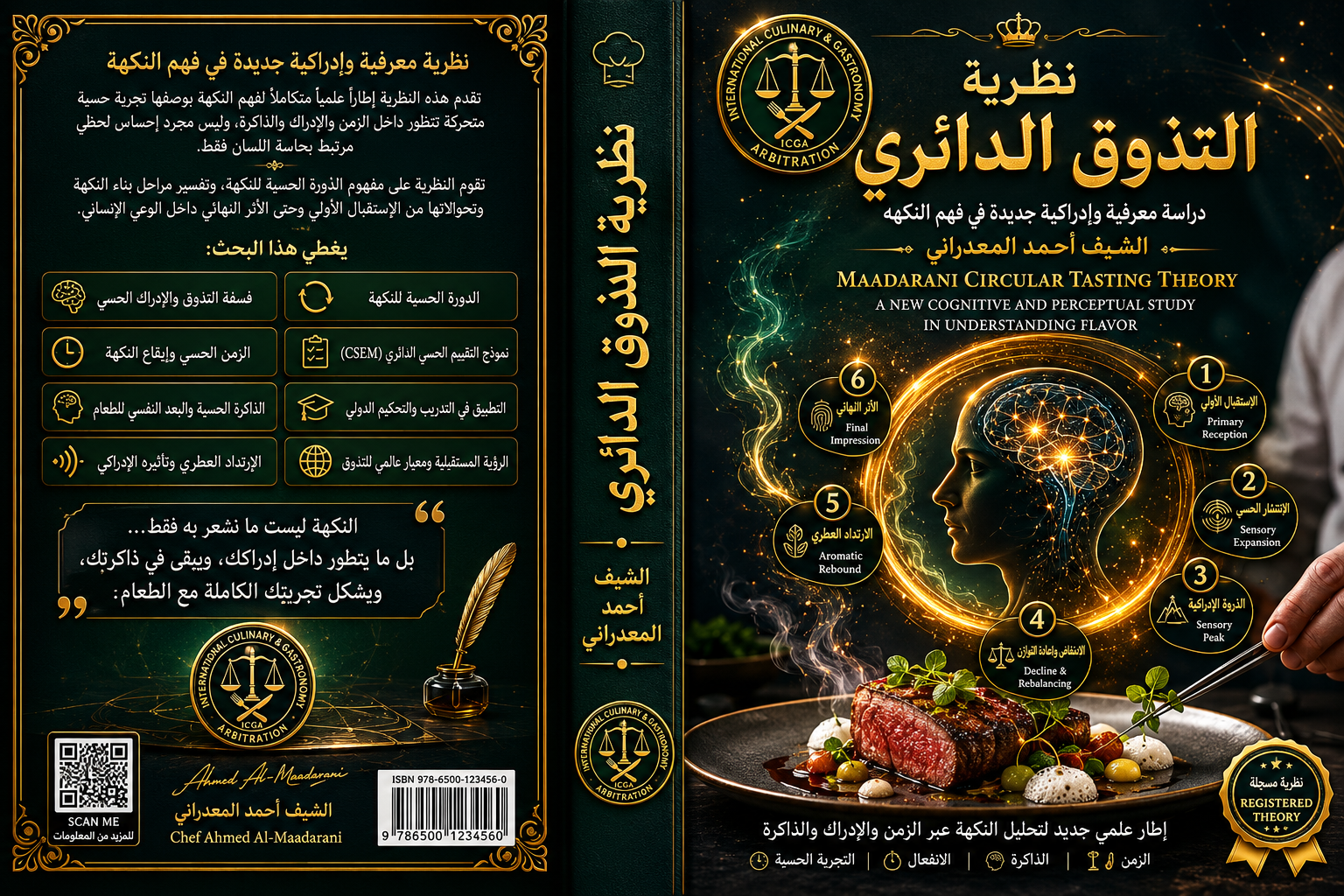
المعدراني، أحمد. (2026). نظرية التذوق الدائري: دراسة معرفية وإدراكية جديدة في فهم النكهة. IUOAMC Global Platform.
Circular Tasting Theory affirms that food quality does not depend only on the strength of any individual stage, but on the harmony of the complete movement of the cycle. A professional dish is one that allows flavor to move smoothly between the different stages without perceptual interruption or disturbance.
Foods differ in the length and complexity of this cycle. Some possess a short and fast cycle, while others pass through extended stages rich in sensory transformations, especially fermented, aromatically complex, or multilayered foods.
The Circular Flavor Cycle therefore becomes an analytical framework for understanding how flavor moves through time and perception. It transforms tasting from a momentary response into an integrated dynamic process that can be studied, evaluated, and developed with greater depth and professionalism.
Phase One: Primary Sensory Reception
The stage of Primary Sensory Reception is the official beginning of the Circular Flavor Cycle. It is the moment when food meets the senses for the first time. Although this stage is short in duration, it has great importance because it forms the first perceptual impression upon which the brain builds the later stages of tasting.
At this moment, the taste receptors on the tongue begin interacting with the chemical compounds of food. Basic signals associated with sweetness, acidity, bitterness, saltiness, or umami appear. The brain rapidly analyzes these signals in order to create an initial image of the nature and expected quality of the food.
Circular Tasting Theory, however, affirms that this stage does not represent the complete flavor. It is only a “perceptual entrance” into the sensory experience. The first impression may be strong, sharp, or attractive, but it does not necessarily reveal the true depth of the food, because secondary, aromatic, and temporal layers have not yet appeared fully.
The theory uses the concept of Initial Flavor Impression. This refers to the first sensation formed within perception when food touches the senses. This impression is important because it determines the perceptual expectations upon which the brain will build the rest of the experience.
Aroma also plays an early role even during this first stage. Before food actually touches the tongue, aromas have already begun to affect the brain, creating “perceptual preparation” that influences the interpretation of the initial taste. The appearance, aroma, temperature, and presentation of the dish therefore all participate in building the first sensory reception.
The theory notes that some foods rely heavily on the strength of their beginning, especially acidic, spicy, or strongly seasoned foods that aim to create a quick “sensory shock” and attract the taster’s attention from the first moment. Other foods rely on quiet beginnings that allow the sensory cycle to develop gradually without sudden intensity.
The quality of primary reception also differs according to the balance of sensory signals. Taste may be strong but incoherent, leading to perceptual confusion or sensory fatigue from the beginning. Professional foods, however, succeed in presenting a clear but balanced beginning, allowing the taster to enter the sensory cycle without excessive shock or perceptual disorder.
Primary reception is also influenced by the psychological state and sensory attention of the taster. A distracted or tense person may not capture the fine details of the beginning, while focused awareness allows the perception of subtle differences among the initial layers of food.
Within circular tasting, this stage is not considered a final judgment of food quality. It is the “gateway” to the sensory journey. True flavor is not determined fully at the beginning. It is discovered gradually through the temporal and perceptual development of the food.
The theory therefore affirms that Primary Sensory Reception is not the end of evaluation, but the beginning of a complex perceptual path, in which first signals turn into a sequence of transformations and interactions that will continuously reshape flavor through the later stages of the circular cycle.
Phase Two: Sensory Expansion and Flavor Diffusion
After the stage of primary reception, flavor enters a more complex stage known in Circular Tasting Theory as Sensory Expansion. At this stage, taste and aromatic signals begin to move more broadly inside the mouth and olfactory system, allowing secondary layers of food to appear and the perceptual experience to develop gradually.
If the first stage represents the “first sensory shock,” the stage of expansion represents the beginning of the true depth of flavor. At this moment, perception is no longer limited to basic taste. The brain begins capturing fine details related to aroma, texture, temperature, and the internal balance of food.
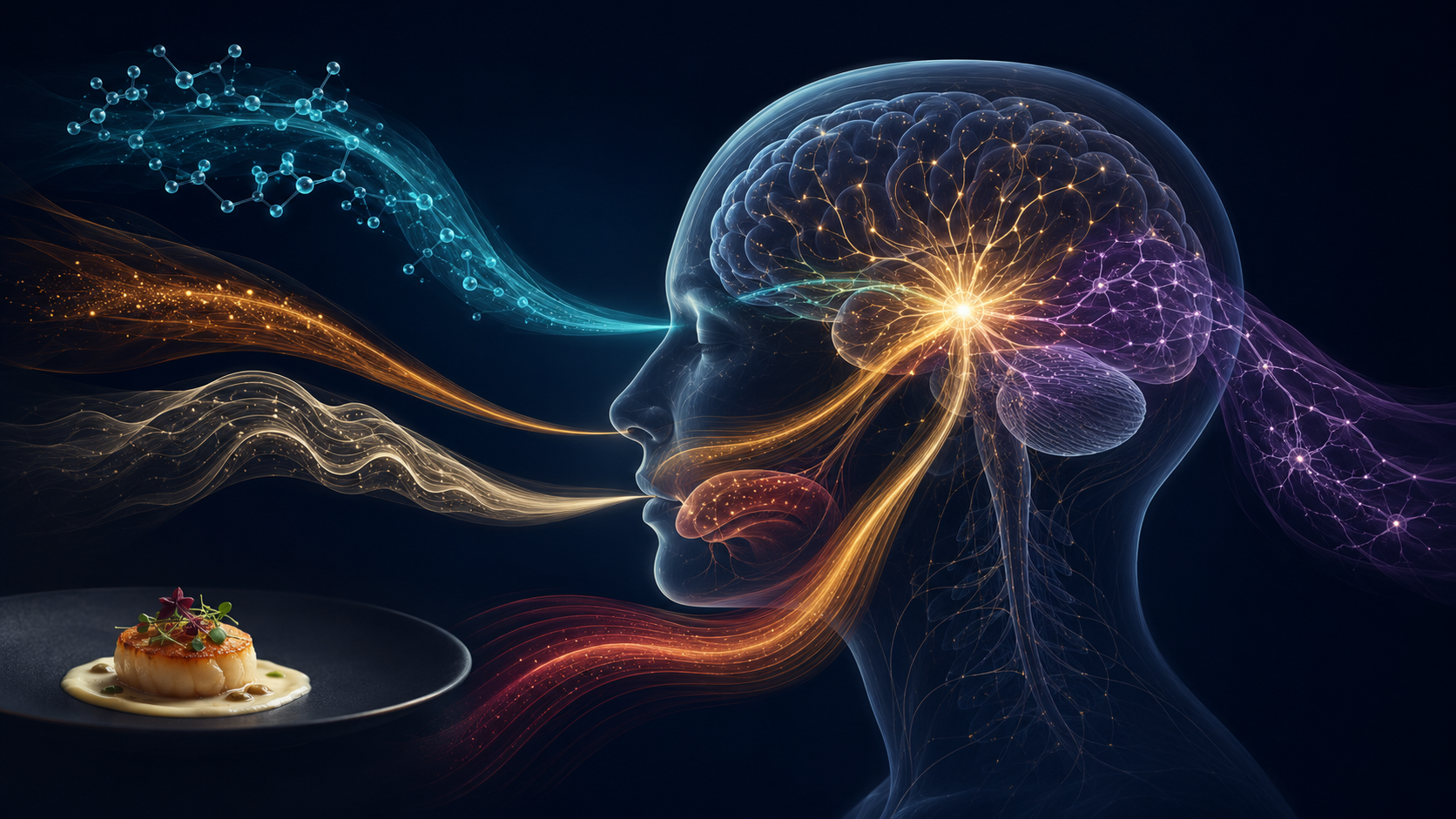
This stage occurs through the simultaneous interaction of several factors: mixing of food with saliva, release of aromatic compounds, movement of chewing, transfer of heat, and the beginning of retronasal breathing. All these elements work together to widen the perceptual space of flavor within the taster’s sensory awareness.
The theory uses the concept of Sensory Diffusion Field. This refers to the perceptual space in which flavor spreads after passing beyond the initial impression. At this stage, flavor becomes less sharp and more complex, as different layers begin to interact and appear gradually.
The theory also holds that food quality at this stage depends on “the ability of flavor to expand without collapsing.” Some foods begin strongly but lose balance during expansion, producing contradictions or sensory disorder inside the mouth. Professional foods, however, preserve harmony while expanding the sensory cycle, giving the taster a feeling of natural progression and perceptual comfort.