المعدراني، أحمد. (2026). نظرية التذوق الدائري: دراسة معرفية وإدراكية جديدة في فهم النكهة. IUOAMC Global Platform.
In traditional models, the end of chewing or swallowing is considered the actual end of tasting. Circular Tasting Theory, however, holds that this moment may be the beginning of a new perceptual stage, in which the brain continues reanalyzing sensory signals and connecting them to memory and psychological emotion. Some foods therefore remain “alive” within perception even after their direct physical trace has disappeared.
The theory uses the concept of Temporal Flavor Memory. This refers to the brain’s ability to retain flavor and recall it over time, whether through remaining aromas, psychological emotion, or sensory connections associated with the food experience. At this stage, flavor changes from a momentary sensation into a long-term perceptual trace.
The theory also indicates that foods differ in their “strength of sensory persistence.” Some foods have a fast and strong effect that disappears quickly. Others create a quieter effect that remains for a long time within memory. Foods with complex aromatic layers or long temporal maturation are often more capable of producing this kind of persistence.
This is clearly evident in specialty coffee, dark chocolate, smoked or fermented foods, where flavor remains present in the mouth and awareness for a long time after eating has ended. In some cases, flavor may return to perception later through breathing or even through thinking about the food, showing that the experience has exceeded the limits of direct sensory interaction.
Temporal memory is also linked to the emotional dimension of food. Foods associated with comfort, childhood, or cultural identity often have a stronger presence in memory because the brain does not store taste alone; it stores the feelings that accompanied it. Some flavors thus become part of a person’s personal history.
From the perspective of circular tasting, “sensory persistence” is one of the professional quality standards of food. A successful dish is not only one that impresses during tasting. It is one that continues to affect the taster after the experience ends. The greater the ability of flavor to remain within perception, the greater its sensory and philosophical power.
The theory also holds that this persistence gives food a form of “temporal extension.” Tasting is not a short event limited by time. It is an experience that extends within awareness and continues to reshape itself after eating has ended.
In this context, the final trace of flavor becomes part of the sensory identity of food, not merely a passing remnant. Some dishes are quickly forgotten despite their technical quality, while others remain present in memory for years because of the depth of their perceptual effect and the continuity of their sensory presence.
Circular Tasting Theory thus affirms that real flavor is not measured only by the moment of tasting, but by its ability to continue within time, awareness, and memory, transforming from a temporary sensation into a long-lasting human experience.
The Circular Flavor Cycle
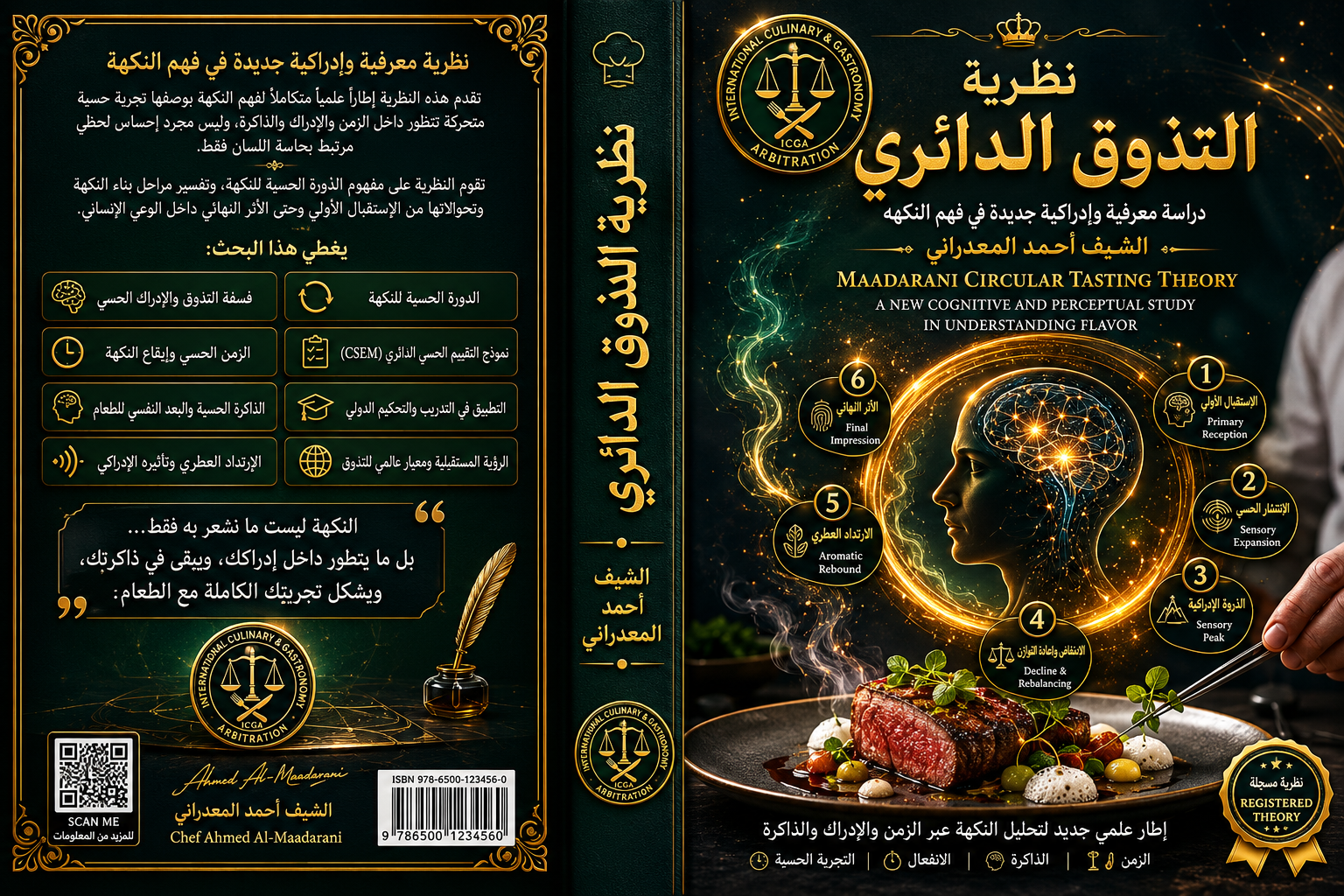
The Circular Flavor Cycle represents the central axis of Circular Tasting Theory. Through it, the movement of flavor within sensory perception is explained as a connected sequence of successive stages, beginning from the first moment of contact with food and ending with the extended perceptual effect within memory. According to this view, flavor does not move in a straight line. It moves through an integrated cycle in which sensations return in renewed and changing forms.
In traditional models, tasting is viewed as an event that begins and ends within a short period. In this model, however, the food experience passes through multiple transformations that together form an integrated “sensory journey.” Each stage of this journey has its own perceptual, psychological, and temporal characteristics.
The cycle begins with what may be called Primary Sensory Reception. At this stage, the tongue receives the basic signals of food, such as sweetness, acidity, saltiness, or umami. This stage represents the first “sensory gateway” into the food experience and is often fast and strong in effect.
Flavor then moves to the stage of Sensory Expansion. Here, aromatic and taste compounds begin to spread inside the mouth and olfactory system. Secondary layers of the food appear, and the perceptual experience becomes more complex. At this stage, the taster begins to notice fine details that were not clear at the beginning.
Flavor then reaches the stage of Sensory Peak. This is the stage in which the sensory experience reaches its highest level of clarity and integration. Taste, aroma, texture, heat, and psychological emotion gather within a concentrated perceptual moment that forms the “sensory summit” of the food.
The peak, however, does not represent the end of the cycle. It is followed by Gradual Decline. In this stage, some sensory signals recede while others remain for a longer time. This stage is important because it sometimes reveals the deeper layers of flavor that did not appear during the direct peak.
Flavor then enters the stage of Aromatic Rebound. Here, aromas and sensory effects return through retronasal breathing or aromatic memory, giving flavor a new “perceptual return” that differs from its first appearance. This stage is one of the most important features that distinguishes circular tasting from traditional linear tasting.
Finally, the cycle reaches the stage of Sensory Aftereffect. At this stage, the experience settles within memory and psychological emotion. Food is transformed from a direct sensation into a long-lasting effect within the taster’s sensory awareness.