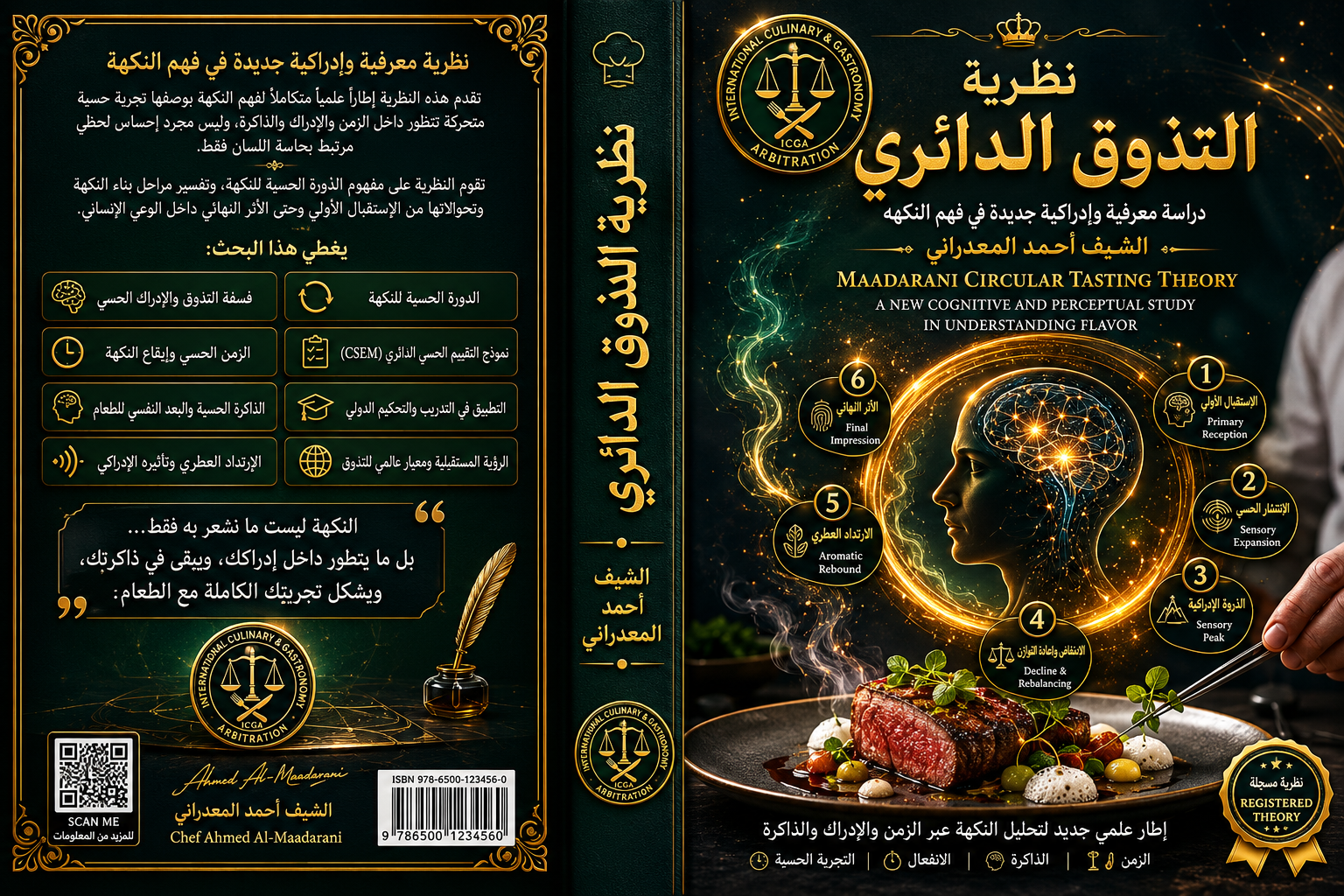
المعدراني، أحمد. (2026). نظرية التذوق الدائري: دراسة معرفية وإدراكية جديدة في فهم النكهة. IUOAMC Global Platform.
Texture also affects the perceptual balance of food. Even if the ingredients are harmonious in terms of taste, an unsuitable texture can disturb the sensory experience. Flavor may be good, but the mechanical sensation may be unpleasant or inconsistent with the movement of the sensory cycle, weakening the final perceptual quality of the food.
Interestingly, some foods rely on “textural gradation” to produce a more complex experience. In modern kitchens, crisp elements may be combined with creamy or liquid elements to create multiple sensory transitions inside the mouth. In this way, not only flavor changes, but also the physical sensation accompanying it.
Texture also plays an important role in memory and psychological emotion. Certain textural compositions are associated in the human mind with comfort, warmth, or childhood, while others may evoke surprise, strangeness, or aversion. The sensation of texture is therefore inseparable from the psychological dimension of the food experience.
Within circular tasting, texture is also a temporal element, because the sensation of it changes during chewing, thermal breakdown, and interaction with saliva. Some foods begin with a firm texture and then gradually transform into a softer or melting sensation, adding a new stage to the perceptual cycle of flavor.
The theory also affirms that professional chefs do not design flavor alone; they design the “movement of texture” inside the mouth. The choice of cooking level, moisture ratio, degree of crunch, and speed of melting are all tools used to organize the food’s sensory journey in an integrated manner.
Texture therefore becomes a basic part of flavor identity rather than an element separate from it. The physical structure of food becomes an active partner in building the sensory cycle and guiding the movement of flavor within time, perception, and memory.
Circular Tasting and the Cognitive Awareness of Food
Circular Tasting Theory holds that true tasting does not occur entirely automatically. It requires a level of cognitive awareness that allows the taster to notice the subtle transformations flavor undergoes during the sensory cycle. Many people consume food quickly and mechanically, perceiving only the surface layer of taste without reaching the true depth of the food experience.
“Cognitive awareness of food” refers to the human ability to concentrate sensory attention and observe the changes that occur within flavor over time. The higher the level of attention, the greater the brain’s ability to capture the aromatic, thermal, textural, and emotional details connected to food.
In traditional tasting, the focus is often on direct judgment: Is the food delicious or not? In circular tasting, the taster becomes a participant in analyzing the sensory journey itself, observing how flavor appears, transforms, disappears, returns, and affects the psyche over time.
The theory uses the concept of Cognitive Flavor Awareness. This refers to the mental state in which the taster becomes able to follow the internal movement of food within perception rather than being limited to immediate, direct response. In this state, tasting becomes a contemplative process that combines sensation, attention, and internal analysis.
The theory also affirms that conscious perception changes the quality of tasting itself. Complex foods do not reveal all their layers to an inattentive taster, while their delicate details appear during slow and focused tasting. The same dish may therefore seem ordinary to one person and exceptional to another who possesses a higher ability for sensory attention.
This awareness is also connected to the temporal rhythm of food. Rushing through eating often causes later stages of the sensory cycle to disappear, especially aromatic rebound and flavor reconstruction within memory. Conscious tasting, however, gives flavor the chance to develop fully within perception.
From the perspective of circular tasting, cognitive awareness is not limited to noticing taste. It also includes recognizing the speed of sensory transformations, the balance of layers, thermal changes, aroma development, the relationship between texture and time, and the psychological effect of food. Tasting thus becomes closer to a “sensory reading” of food than to a rapid consumer response.
The theory also holds that cognitive awareness is linked to experience and training. A professional taster or international judge has a greater ability to divide the sensory cycle into stages and analyze each stage separately, while an ordinary taster often focuses only on the general impression.
For this reason, training programs can be developed based on “conscious tasting” in order to increase the competence of chefs, judges, and specialists in sensory analysis. These programs would teach trainees how to follow the movement of flavor through time, notice hidden layers, and understand the relationship among the senses, perception, and psychological emotion.
Circular Tasting Theory therefore affirms that flavor is not only what food provides, but also what the mind is able to notice, analyze, and absorb. The higher the level of cognitive awareness, the deeper, richer, and more complex the food experience becomes, transforming tasting from a consumer act into an integrated cognitive and sensory experience.
Temporal Flavor Memory and Sensory Persistence
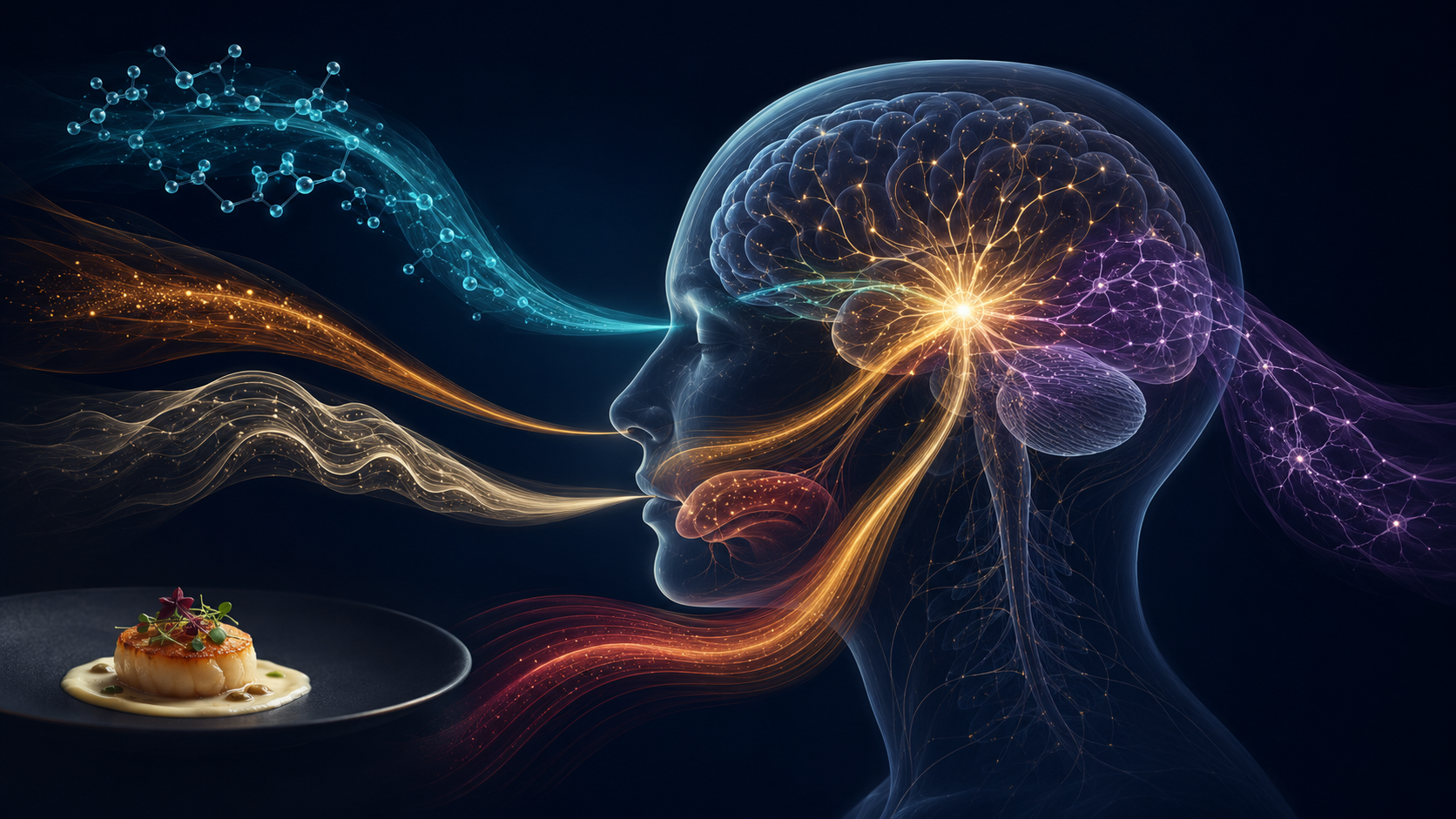
One of the most important ideas presented by Circular Tasting Theory is that flavor does not end when food ends. It continues within perception through what may be called “temporal flavor memory.” Some foods have the ability to remain within sensory awareness for a long period after direct tasting has ended. This makes the final effect part of the food experience, not merely a later result of it.