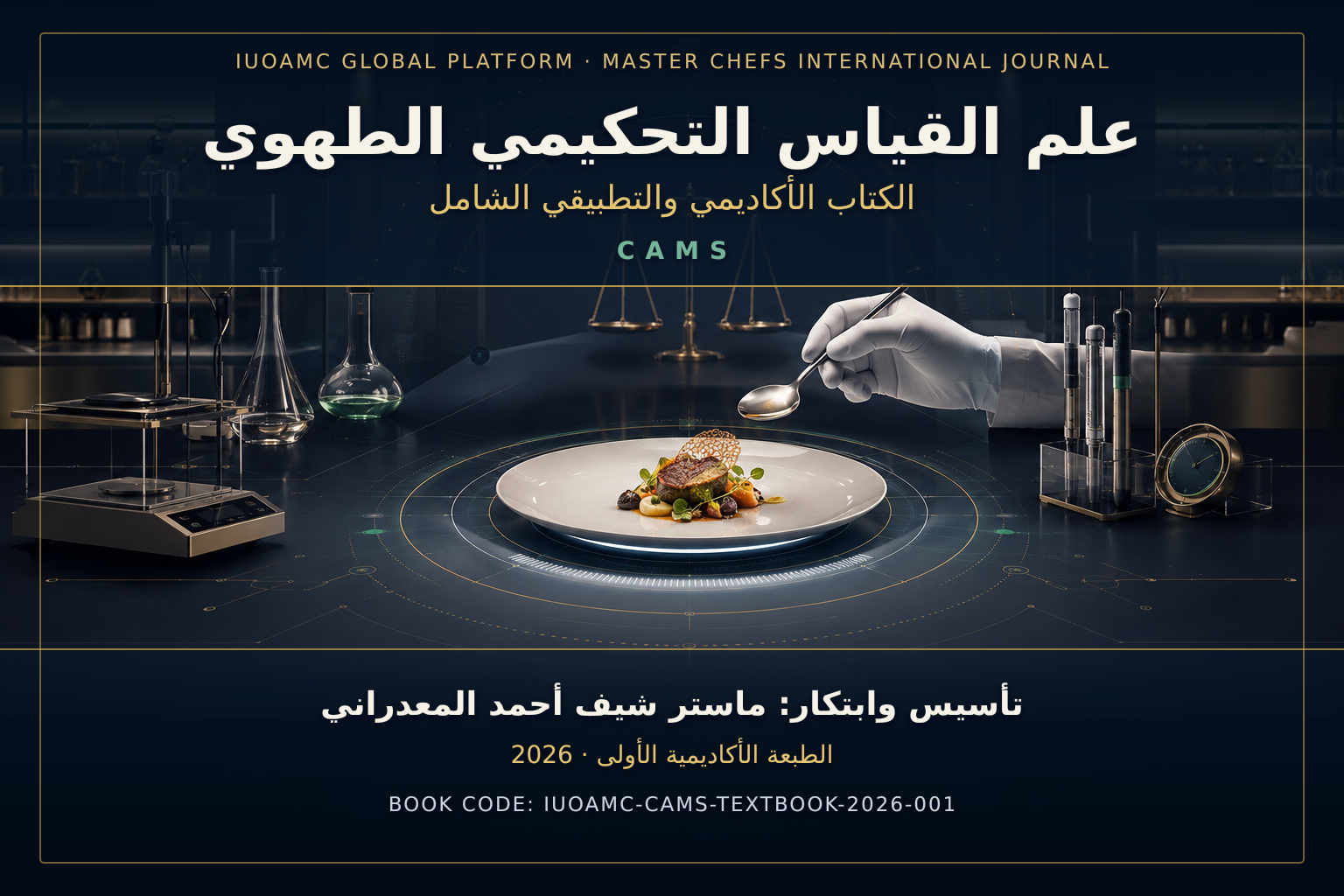
Maadarani, A. (2026). Culinary Adjudication Measurement Science: Comprehensive Academic and Applied Textbook. IUOAMC Global Platform.
CAMS in Fine Dining
Learning outcomes
After completing CAMS in Fine Dining, the learner will be able to:
- define CAMS in Fine Dining operationally and link it to a CJE;
- distinguish the effect of Kitchen from the effect of Path in a decision;
- build a record combining Table and Synchronization without erasing first data;
- perform a controlled comparison specific to CAMS in Fine Dining and explain its limits; and
- defend a traceable CAMS in Fine Dining decision before a review panel.
Scientific definition
In fine dining, CAMS measures component synchronization, experience path, and service stability across tables without reducing quality to decoration or complexity.
Within CAMS, CAMS in Fine Dining is studied through transfer of CAMS into an advanced applied setting. The process fixes Kitchen before the outcome appears, measures Path inside a declared window, and documents Table as a repeatable procedure. Synchronization determines how the result moves from observation to authorized decision. Description, score, and confidence remain separate, while raw values and every later transformation remain visible in the event record.
Operational structure
| Element | Function within CAMS | Verification question |
|---|---|---|
| Kitchen | Establish the starting point or source | Was it defined before the outcome appeared? |
| Path | Describe a factor capable of changing the decision | Was it measured independently? |
| Table | Convert the concept into a repeatable procedure | Were essential conditions controlled? |
| Synchronization | Connect the outcome with authority and authorization | Can its evidence be retrieved? |
A CAMS in Fine Dining result does not gain authority merely by being recorded. It becomes usable when Kitchen is defined, Path is measured independently, Table is performed under reviewable conditions, and Synchronization is linked to retrievable evidence. If Kitchen and Path move together, the event is classified as composite and causal attribution waits for a test separating them.
Mind map
Applied case
The dish succeeded at a nearby table and failed at another because of transport time. The system converted observation into a service-layout correction rather than blaming the chef alone.
This case is read through three connected paths. The first establishes from the raw record what happened to Kitchen; the second tests whether Path changed independently; and the third examines the relationship between Table and Synchronization through an appropriate comparison. A small model of the target setting is built, then transferability, limits, and resources are tested before institutional scale-up. The explanation is authorized only if it remains valid after this separation; when two explanations survive, the discriminating test is specified instead of choosing by intuition.
Applied laboratory
Objective
Build a small CAMS in Fine Dining protocol that another learner can repeat, showing how measurement moves from Kitchen and Path through Table to a decision connected with Synchronization.
Laboratory design
Map the dish journey from kitchen to three tables and identify risk points.
Procedure
- Convert the definition of CAMS in Fine Dining into an acceptance criterion fixing the location and limits of Kitchen before results are viewed.
- Prepare the CAMS in Fine Dining sample, code, and time window required to measure Path without unintended disclosure.
- Run an independent CAMS in Fine Dining baseline and close Table, description, score, and confidence before discussion.
- Perform the comparison stated in the CAMS in Fine Dining laboratory, changing one known factor connecting Kitchen with Synchronization.
- Test within CAMS in Fine Dining whether movement arose through transfer of CAMS into an advanced applied setting, and record at least one alternative explanation.
- Issue a reasoned decision to use, repeat, or exclude the CAMS in Fine Dining result and identify the authorizing role.
Results card
| Event | Kitchen | Path | Table | Synchronization | Confidence | Use decision |
|---|---|---|---|---|---|---|
| A | ||||||
| B | ||||||
| Repeat |
Practical assessment
The learner receives a subject file on CAMS in Fine Dining containing conflicting measurements of Kitchen and Path, a partial record of Table, and an initial decision whose connection with Synchronization is unclear. The learner reconstructs the event, separates usable from missing data, performs the test that distinguishes the strongest explanation, and reports the raw result, treatment, and authorization limits. An answer that erases an earlier value or attributes change to an uncontrolled factor is not accepted.
Assessment rubric
| Criterion | Weight |
|---|---|
| Accuracy and use limits of the CAMS in Fine Dining definition | 15 |
| Integrity of controls for Kitchen and Path | 20 |
| Quality of Table and raw-data registration | 15 |
| Validity of the test involving Synchronization | 15 |
| Interpretation within transfer of CAMS into an advanced applied setting | 15 |
| Completeness of this subject’s evidence chain | 10 |
| Professional and ethical defense of the decision | 10 |
| Total | 100 |
Core terms
- Kitchen: the starting point that must be fixed when measuring CAMS in Fine Dining.
- Path: the factor tested as an explanation for movement in CAMS in Fine Dining within transfer of CAMS into an advanced applied setting.
- Table: the recorded procedure allowing the CAMS in Fine Dining test to be repeated.
- Synchronization: the link between analysis of CAMS in Fine Dining and the authorized decision.
Conclusion
CAMS in Fine Dining adds a defined CAMS capability: it establishes Kitchen, separates the effect of Path, makes measurement of Table repeatable, and prevents the Synchronization component from influencing authorization without evidence. Its value appears within transfer of CAMS into an advanced applied setting when raw observation is preserved and an independent reviewer can reconstruct the path from event to decision. Expertise in this subject thereby becomes teachable and auditable practice.