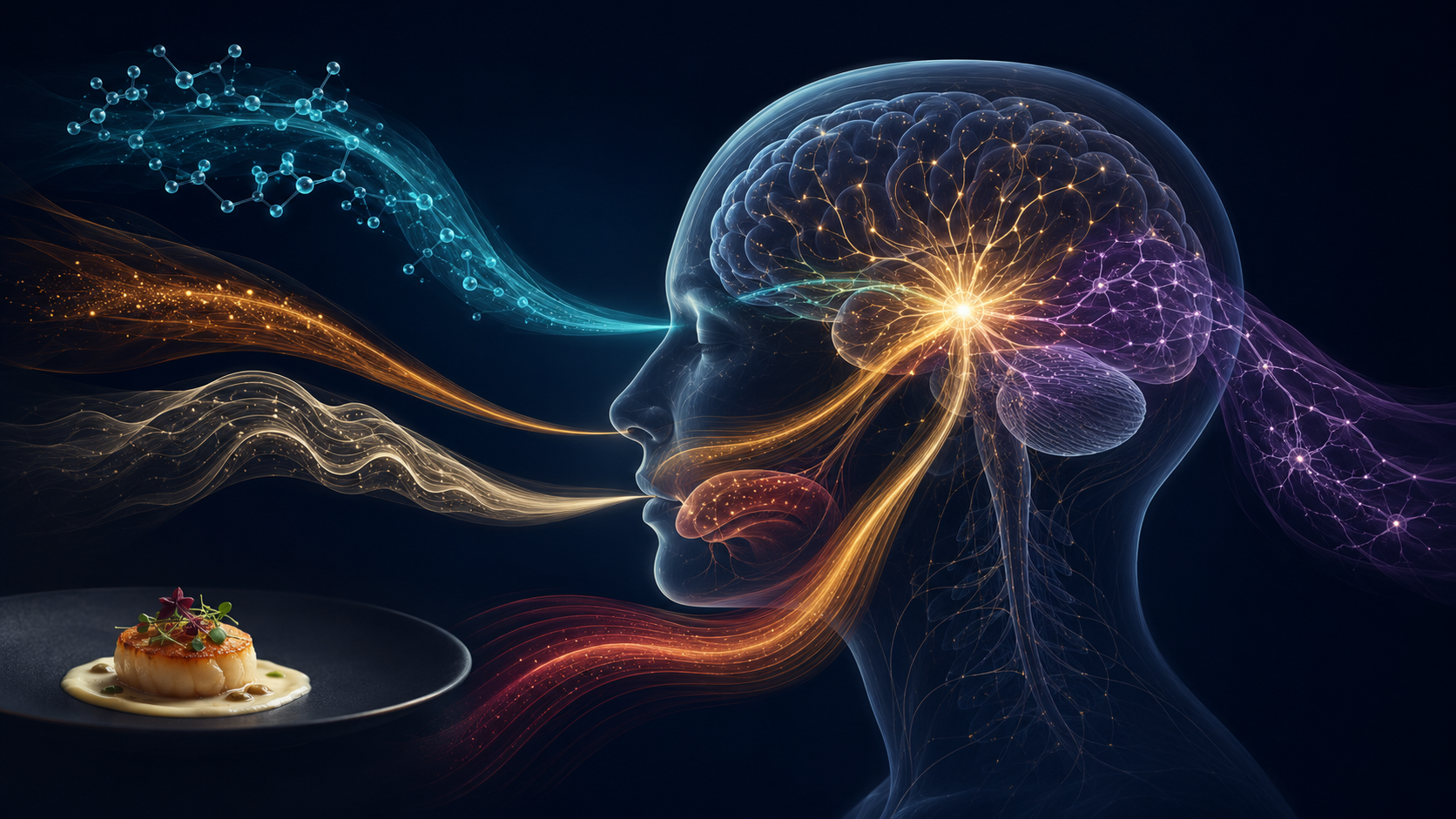
Maadarani, Ahmad. (2026). Tasting does not occur in the tongue alone: From chemical taste to flavor construction in the brain. IUOAMC Scientific Magazine, International Union of Arab Master Chefs. Research Archive Code: IUOAMC-MV2-2026-FNS-001.
- Does not reduce flavor to smell alone.
- Does not assume that every reduction in flavor is caused by the nose.
- Does not consider taste–odor interactions identical among all individuals.
- Does not separate perception from the actual properties of food.
- Does not transform the conceptual model into a diagnostic equation.
- Does not replace standardized sensory testing or medical examination.
- Does not allow personal preference to be presented as objective fact.
The central idea is that the unity of the experience does not imply unity of its source. Flavor may appear to be one sensation even though it arises from multiple signals integrated by the brain into a coherent entity.
Conclusion
The tongue is not a complete laboratory for flavor but one of its principal gateways. It detects basic tastes and contributes to identifying certain chemical properties of food, while retronasal olfaction provides much of food’s aromatic identity.
Oral sensation contributes texture, temperature influences compound release and perceptual intensity, and chemical sensory systems contribute heat, cooling, tingling, and pungency. Memory, expectation, language, and culture then participate in interpreting these signals.
Flavor is therefore not a point located on the tongue. It is a multisensory neural and perceptual event. It does not emerge in its final form until the brain integrates its components and gives them a unified identity.
This leads to a fundamental principle in tasting education and professional judging:
A judge cannot evaluate flavor with the tongue alone because the object being evaluated is not an isolated taste. It is an integrated sensory construction produced through multiple systems and given its final meaning by the brain.
Professional training should not begin and end with memorizing the names of basic tastes. It should teach evaluators how to deconstruct flavor into its sensory sources, understand its development inside the mouth, distinguish sensation from preference, and reconstruct their observations as a clear, balanced, explainable, documentable, and reproducible judgment.