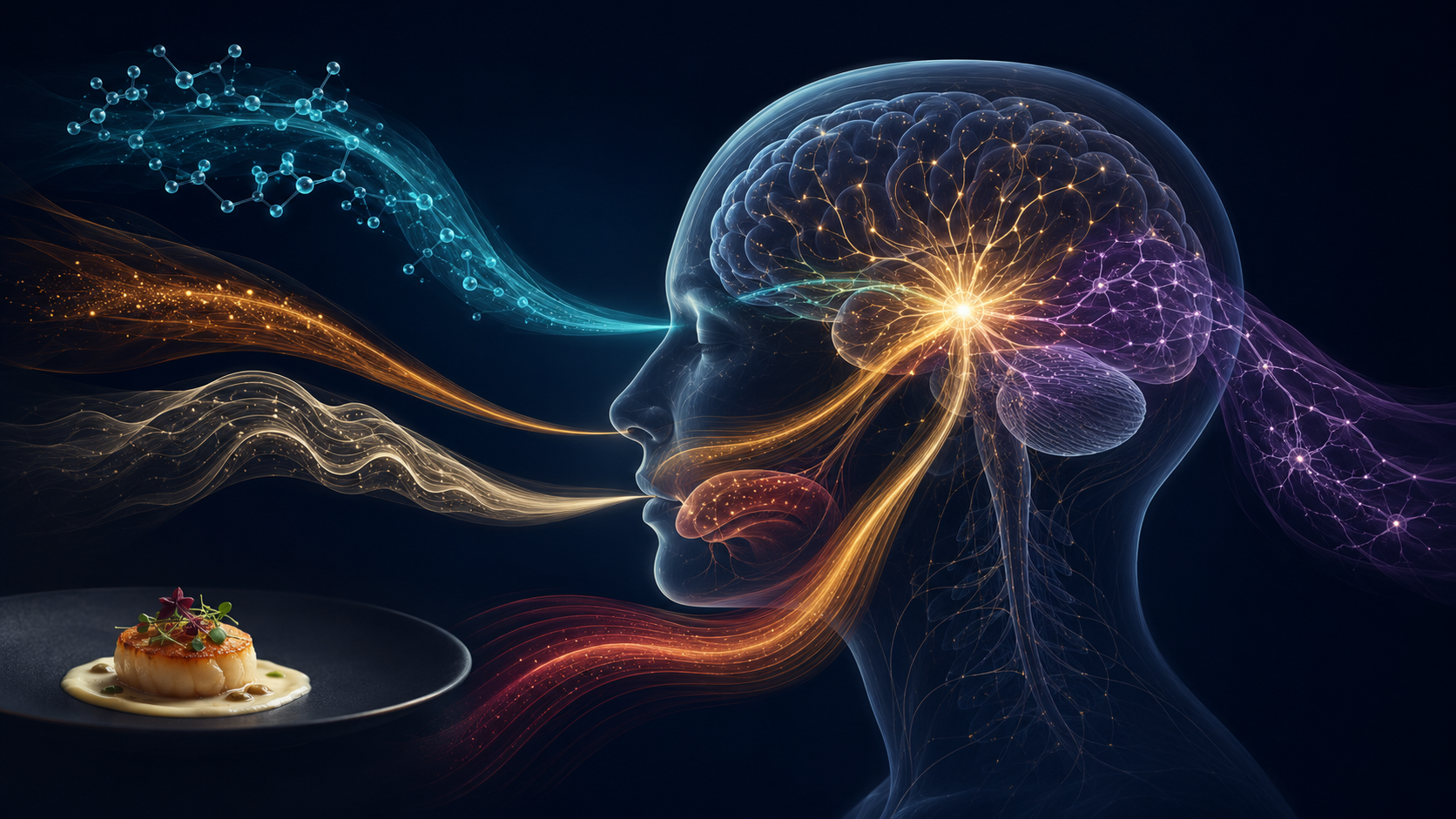
Maadarani, Ahmad. (2026). Tasting does not occur in the tongue alone: From chemical taste to flavor construction in the brain. IUOAMC Scientific Magazine, International Union of Arab Master Chefs. Research Archive Code: IUOAMC-MV2-2026-FNS-001.
A more recent human study using neuroimaging and multivariate pattern analysis found that tastes and their associated retronasal odors may evoke overlapping flavor-specific neural representations in the insular cortex, particularly in the ventral anterior insula. This may help explain how certain aromas associated with sweet or savory tastes can evoke taste-like qualities without direct stimulation from a tastant.
These findings do not mean that the nose literally tastes or that taste and smell are anatomically one sense. They indicate that signals originating from different sensory systems can interact within shared or closely connected neural networks to construct flavor identity.
Eighth: Why Do People Think They Have Lost Taste When Their Nose Is Blocked?
When the nose is blocked or olfactory function is impaired, a person may remain able to perceive:
- The sweetness of sugar.
- The saltiness of salt.
- The sourness of acids.
- The bitterness of certain compounds.
- The umami character of broth or meat.
Nevertheless, foods may seem dull or similar because an important part of their aromatic identity has become weak or absent.
A person may recognize that a sample is sweet but be unable to distinguish fully among strawberry, vanilla, and mango when volatile compounds do not reach the olfactory receptors efficiently.
The statement “I have lost my taste” may therefore accurately describe the person’s subjective experience without precisely identifying which sensory function has been affected.
This explanation should not be treated as an automatic medical diagnosis. Genuine taste disorders exist, and taste and smell disorders may occur together. A distinction should be made among:
- Reduced detection of basic tastes.
- Reduced orthonasal olfaction.
- Reduced retronasal olfaction.
- Difficulty recognizing flavor.
- Inability to name an odor despite detecting it.
- Temporary sensory adaptation.
- Fatigue caused by repeated sampling.
- Effects of medication, smoking, or health conditions.
Ninth: The Mouth as a Dynamic Environment for Flavor Construction
The mouth is not a passive container in which a sample is placed. It is a constantly changing mechanical, chemical, and thermal environment.
During chewing:
- The physical structure of food is broken down.
- The exposed surface area increases.
- Compounds mix with saliva.
- The temperature of the sample may rise or fall.
- Volatile compounds are gradually released.
- Air travels toward the posterior nasal pathway.
- Taste, aroma, and texture change over time.
Experiments have shown that oral movements, swallowing, and spitting can alter perceived retronasal odor intensity, confirming that odor perception during eating is a dynamic process.
This demonstrates the importance of texture in flavor design. Two products may contain similar aromatic compounds but release them at different rates because of differences in:
- Viscosity.
- Fat content.
- Moisture.
- Porosity.
- Temperature.
- Dissolution rate.
- Chewing requirements.
- Time spent inside the mouth.
A solid product may gradually release aromas during continued chewing, while a light liquid may release its aroma quickly and then lose it rapidly. Fat may retain some volatile compounds and delay their appearance, while heat may increase the release of certain compounds.
Flavor should therefore be evaluated as a temporal process with a beginning, development, peak, and conclusion, rather than as a fixed moment.
Tenth: Texture, Temperature, and Chemical Sensation
The food experience includes information that does not belong directly to taste or smell, including:
- Hardness and brittleness.
- Viscosity and density.
- Smoothness and roughness.
- Dryness and juiciness.
- Fatness and astringency.
- Warmth and coldness.
- Tingling and effervescence.
- Chili heat.
- Menthol cooling.
- Mustard and ginger pungency.
These elements contribute to mouthfeel and help determine the identity and quality of the product. A dish may possess a desirable aroma and balanced tastes but still fail because of a sandy texture, unsuitable viscosity, dryness, excessive greasiness, or an incorrect serving temperature.
The heat produced by chili is not a basic taste, nor is menthol cooling a “cold taste.” These are chemical stimuli detected largely through somatosensory pathways and the trigeminal system.
Temperature also affects the release of aromatic compounds and the intensity of tastes. Certain products may appear less sweet or less aromatic when served excessively cold. Higher temperatures may increase aroma release or reveal defects that were previously difficult to detect.
Serving temperature should therefore be recorded as part of the evaluation conditions rather than treated as a secondary detail.
Eleventh: Memory, Expectation, and Culture
People do not enter a tasting experience with minds free from previous experience. Color, name, price, presentation, the chef’s reputation, product identity, and cultural origin create expectations before consumption.
The color red may create an expectation of strawberry or cherry flavor. Describing a product as luxurious may raise expectations, while a familiar aroma may evoke a family memory or a previous positive or negative experience.
This does not mean that flavor is an illusion or disconnected from the properties of food. It means that perception arises through interaction between an external stimulus and a nervous system shaped by experience.
The evaluator does not record food like a neutral camera. Information is interpreted and compared with references stored in sensory memory.
This influence becomes particularly significant in professional judging when the judge knows:
- The competitor’s name.
- The institution represented by the competitor.
- The competitor’s nationality.
- The product’s price.
- The brand.
- The competitor’s order.
- The scores assigned by other judges.
Such information may create bias before sensory analysis begins. Whenever possible, samples should therefore be coded, unnecessary information concealed, and presentation order carefully controlled.