Ahmad Maadarani. (2026). The Birth of a New Global Culinary Arbitration System. IUOAMC Global Magazine. IUOAMC/GOV/2026/001.
The culinary and gastronomy sector is witnessing an unprecedented global transformation. Modern institutions are no longer built on the traditional “single union” model that combines education, arbitration, standards, professional titles, and governance within one entity.
The world is now moving toward:
- Institutional specialization
- Professional governance
- Independent references and authorities
- Separation of professional powers
- Development of independent standards systems
Within this context, the International Union of Arab Master Chefs has entered a historic transformation phase aimed at establishing a new global model based on institutional specialization and independence.
From a Traditional Union to a Multi-Entity System
The organization initially began as an international professional union focused on uniting chefs, supporting education, and organizing professional activities.
However, with international expansion, it became evident that the field of arbitration and professional standards required an independent institution capable of providing:
- Independent standards authority
- Specialized professional governance
- Separate legal and institutional frameworks
- The ability to develop independent international arbitration systems
This marked the beginning of institutional separation between:
🏛️ The Academic & Union Sector
Represented by:
INTERNATIONAL UNION OF ARAB MASTER CHEFS LTD
UKPRN: 10099301
⚖️ The International Arbitration & Standards Sector
Represented by:
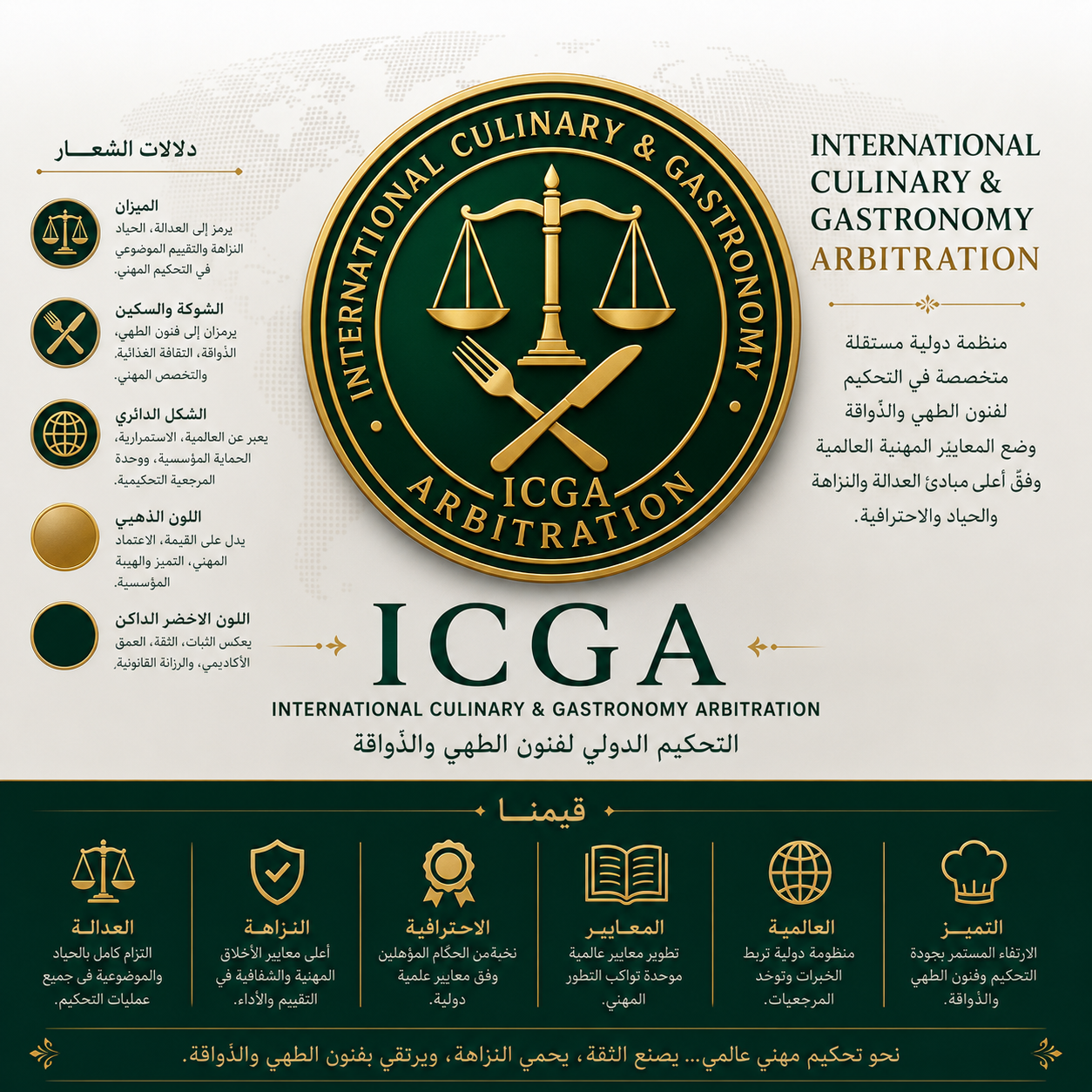
INTERNATIONAL CULINARY & GASTRONOMY ARBITRATION LTD
UKPRN: 10101250
Independent Registration as UK Educational Providers
Reflecting this institutional transformation, each entity became independently registered within the:
UK Register of Learning Providers
as a separate education and training provider in the United Kingdom, with:
- Independent UKPRN numbers
- Separate institutional identities
- Distinct professional structures
- Independent organizational frameworks
This registration represented a major step toward building a more professional and sustainable international institutional structure.
Why Did Arbitration Become an Independent Institution?
Professional arbitration is no longer merely an activity attached to competitions or associations.
It has become:
- A professional authority
- An evaluation reference
- A governance system
- A standards framework
- A professional compliance mechanism
- A quality assurance structure
For this reason, the establishment of:
INTERNATIONAL CULINARY & GASTRONOMY ARBITRATION LTD
created an independent international system specialized in:
- International arbitration
- Judge preparation and certification
- Standards development
- Professional governance
- Culinary compliance
- Evaluation methodologies
Thus, arbitration became:
“An independent institution”
rather than merely a supporting activity.
The Emergence of International Arbitration & Standards Institutions
As part of this transformation, several international institutions and academies emerged, including:
- Global Culinary Judges Academy
- International Culinary Arbitration Academy
- International Gastronomy Standards Institute
- World Academy of Culinary Arbitration
- Academy of Gastronomic Diplomacy
- International Culinary Compliance Academy
- Global Institute of Culinary Arbitration & Standards
- World Supreme Culinary Arbitration Academy
- International Authority for Gastronomy Standards
These institutions represent part of the global movement toward establishing independent professional systems for arbitration, standards, and governance.
Professional Governance and the Future of the Sector
The future of culinary arts will no longer rely solely on individual skills or competitions.
It will depend on:
- Independent arbitration systems
- Clear professional standards
- International governance
- Academic references
- Compliance institutions
- Professional evaluation frameworks
Therefore, building a multi-entity institutional system has become a genuine necessity for keeping pace with the global evolution of the culinary and gastronomy sector.
The Philosophy of Institutional Awareness
Great institutions are not built merely through media presence or membership numbers.
They are built through:
- Vision
- Sustainability
- Governance
- Institutional references
- Structural strength
This philosophy is reflected in the following principle:
“We are not a union of numbers…
We are a union of awareness.
Numbers create temporary presence, but awareness creates legacy and preserves institutional strength through time.”
Conclusion
What is happening today is not merely organizational expansion.
It is the beginning of redefining:
- Arbitration
- Education
- Standards
- Professional governance
- Institutional authority in culinary and gastronomy arts
It is the birth of a new global model based on:
Specialization, independence, and modern professional governance.